
3D Print Surface Finishing Solutions - BAM

High-Quality Sandblasting for Metal & Plastic 3D Printed Parts
Addiblast BAM (Blaster for Additive Manufacturing) is a series of surface finishing systems engineered for the unique demands of 3D printed parts. These solutions use abrasive blasting (often referred to as sandblasting or shot blasting) to smooth, clean, and finish both metal and polymer components produced by additive manufacturing. The BAM lineup includes a manual blasting cabinet and an automated blasting system, both delivering consistent, high-quality finishes optimized for industrial requirements in aerospace, medical, automotive, space, and other advanced fields.
By combining decades of FerroECOBlast expertise with modern automation, Addiblast BAM ensures every 3D printed part achieves the desired surface quality, functionality, and aesthetics.

The Problem We Solve
As 3D printing technology advances, achieving high-quality finishes on printed parts is becoming increasingly important. Our surface treatment solutions are designed to address this need by providing precise and efficient sandblasting for both metal and plastic parts. These solutions not only enhance the aesthetic quality of the parts but also improve their functionality by ensuring smooth and clean surfaces.
Why is surface finishing critical?
Virtually every 3D printed product requires some form of post-processing to improve its strength, performance, and appearance. As 3D printing technology advances and parts become more complex, achieving the required surface quality can be challenging. Raw additive-manufactured parts often exhibit visible layer lines, rough textures, or residual powder. For example, laser-melted metal parts can have rough surfaces (R_a 5–15 μm) due to partially fused powder, and SLS polymer parts (nylon) often show a grainy finish (R_a ~10–20 μm) from sintered powder.
In such cases, abrasive blasting is a powerful technique to smooth and clean the surface, removing unfused powder and reducing surface roughness. The BAM surface treatment systems directly address this need by providing controlled, repeatable blasting processes that enhance part aesthetics and functionality. Smooth surfaces can improve mechanical performance (reducing stress concentrators and friction), ensure proper fit of assembled components, and prepare parts for secondary operations like painting or coating.
Challenges in 3D Print Surface Finishing
Traditional hand sandblasting or sanding relies on operator skill and can lead to inconsistent results part-to-part. Manual finishing is also labor-intensive and hard to scale for production volumes. This inconsistency can be problematic when tight surface roughness specifications (e.g. a target Roughness Average Ra value) must be met on every part. Addiblast’s BAM series overcomes this by introducing automation and process control. The BAM10 automated unit, for instance, uses a programmable blasting cycle (with controlled pressure, time, and media flow) to ensure every piece in a batch receives the same treatment. This means every finished part meets your specifications for surface texture and cleanliness, with excellent repeatability from the first part to the hundredth. By automating surface finishing, manufacturers can achieve uniform roughness and appearance on all parts, eliminating the variability of manual methods.
Additive manufacturing enables complex geometries, including internal channels, lattice structures, and intricate details. Such features are difficult to finish with traditional tools. The BAM systems are designed specifically for additive geometries – they can effectively blast uneven surfaces and hard-to-reach areas. The manual BAM03 cabinet gives a technician the precision to target specific features or delicate sections, while the BAM10’s dual-nozzle rotary drum can expose all part surfaces to the blast media in an automated cycle. This combination of manual and automated capability means even complex 3D printed parts can be uniformly finished. Delicate lattice walls or internal passages can be cleaned of powder and lightly blasted without damage, improving part reliability (for example, ensuring no loose powder remains in a cooling channel of an aerospace heat exchanger).
When production ramps up, post-processing should not become a bottleneck. Hand-finishing each part is impractical for batches of dozens or hundreds. BAM10 addresses this with its 50-liter rotating drum and dual blasting nozzles, allowing multiple parts to be finished in one automated cycle. Parts can be loaded in the drum and blasted evenly as the drum rotates, significantly boosting throughput. Meanwhile, the operator is free to perform other tasks or prepare the next batch. This lights-out finishing capability means the additive manufacturing post-print workflow scales smoothly – printing, depowdering, and surface treatment can all be automated steps. In fact, PostProcess Technologies (another AM post-processing provider) notes that automated finishing can free up operators and ensure post-print steps never hinder production. With BAM, you can run continuous finishing cycles with minimal supervision, increasing productivity.
In critical industries like aerospace or medical, surface finish is more than cosmetic – it can impact performance and compliance. For example, aerospace turbine parts or satellite components may require polished surfaces to reduce aerodynamic drag or outgasable residue, and medical implants might need very smooth or uniformly textured surfaces for functional reasons. The Addiblast BAM systems produce high-quality finishes that meet these stringent requirements. By selecting appropriate blasting media and parameters, operators can achieve finishes ranging from matte satin (for improved paint adhesion) to a polished sheen (for reduced friction). Roughness values can be significantly lowered: abrasive blasting can take a rough as-printed surface and bring it closer to machining-level smoothness, depending on media. This improves not only appearance but also mechanical properties – for instance, reducing surface roughness can improve fatigue life of metal parts by removing stress risers. Furthermore, BAM blasting can serve a dual purpose of peening the surface of metal parts (if using shot peening media), introducing compressive stress that enhances fatigue strength. The ability to roughen or texture surfaces is also valuable: e.g., creating a uniform rough texture on a medical implant to aid bone integration, or adding a satin finish to a consumer product for better grip. The BAM systems give you control over surface profiles to match the application needs.
Especially for metal additive manufacturing (like SLM/DMLS), removing all residual powder is critical for part functionality and safety. Fine metal powders (such as titanium or aluminum) trapped in cavities not only hinder performance but can be explosive hazards if not handled properly. Addiblast’s surface treatment solutions work hand-in-hand with its depowdering systems (the MARS series) to ensure parts are completely powder-free. After initial depowdering, BAM blasting can dislodge any stubborn particles and produce a clean final surface. For plastics (e.g. SLS nylon), blasting removes the caked-on powder and “refreshes” the surface from a chalky texture to a uniform finish. The BAM cabinets are equipped with effective dust extraction and media recycling so that removed powder and used abrasive are captured and either recycled or disposed of safely. Notably, the BAM03 is available in an ATEX-certified version (BAM03 EX) for working with reactive metal powders in a safe environment. This explosion-proof design and options for inert operation (e.g., using nitrogen) ensure that even aluminum or titanium powder can be handled without risk. In summary, the BAM series helps maintain a safe and clean post-processing workflow, critical for industries with strict safety standards.
Addiblast BAM Series: Manual vs. Automated Blasting Options
The BAM product line encompasses two primary solutions to cover different production needs:
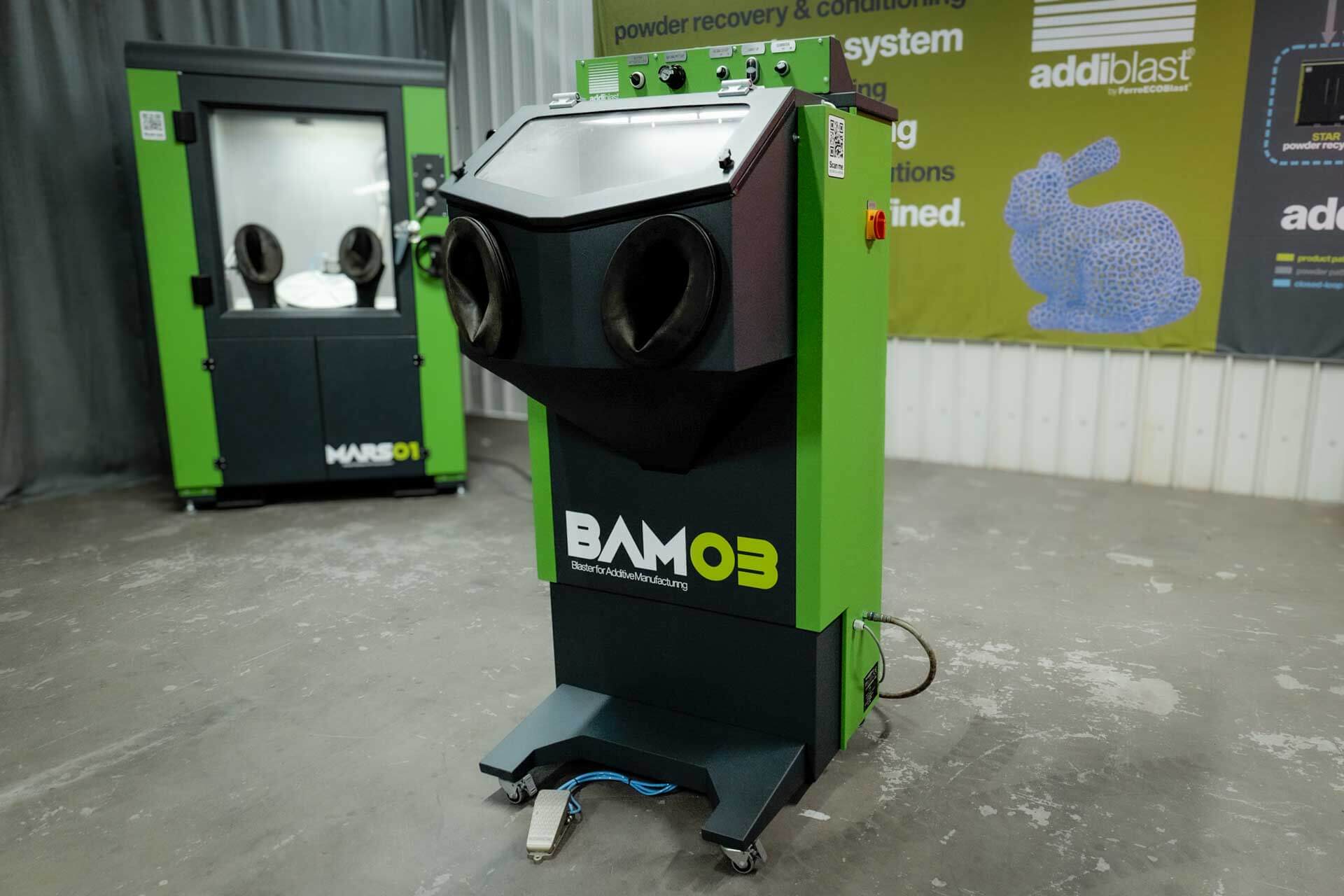
BAM03 – Manual Blasting Cabinet: A compact, ergonomic blast cabinet designed for precision work on 3D printed parts. The operator accesses the chamber through built-in heavy-duty gloves, viewing the part through a large window under LED lighting. This setup is ideal for detailed finishing tasks or low-volume jobs. Engineers can manually blast specific areas, adjust angle and distance in real time, and feel the process on custom or delicate pieces.
- BAM03 features adjustable working height (the cabinet height can be electronically adjusted for operator comfort), ensuring an ergonomic stance during operation. The system uses an injector (suction) blasting mechanism by default – a reliable, easy-to-use method where abrasive is drawn into the airflow.
- For more aggressive blasting needs, the BAM03 can also operate in pressure-blast mode using an integrated AddiMiniBlast pressure vessel. This dual-mode capability is unique: it allows quick adaptation between gentle suction blasting and high-power pressure blasting within the same cabinet, a flexibility that generic blasting cabinets typically lack.
- The entire cabinet is constructed of durable stainless steel, making it robust for continuous industrial use and compatible with all types of blasting media (from glass beads and aluminum oxide to steel shot) without contamination.
This manual solution is perfect for R&D labs, custom part makers, or any scenario requiring fine control – for example, finishing a complex aerospace prototype or carefully cleaning a medical device without over-blasting critical features.

BAM10 – Automated Blasting System: A larger, automated surface finishing machine engineered for production environments and consistent batch processing. The BAM10 includes a 50-liter rotary drum (500 mm diameter) inside the blast chamber, which gently tumbles parts as they are blasted by two adjustable blast nozzles. This design enables even coverage on all sides of the parts, making it ideal for cleaning and finishing many pieces in one cycle. For example, dozens of polymer parts from a laser sintering build can be placed in the drum and simultaneously blasted, or a batch of metal components can be finished together, greatly accelerating throughput. The process parameters – blast pressure, time, drum rotation speed, etc. – are all programmable via a touch-screen interface, allowing operators to create and save recipes for different part types. Once parameters are set, the BAM10 can run semi-autonomously: load the parts, start the cycle, and the machine will execute the surface treatment uniformly.
Additionally, the BAM10 retains a degree of manual capability: it has glove ports and a window as well, so operators can perform a quick manual touch-up if needed after the automatic cycle (for instance, if one side of a very large part needs extra attention). Key features of the BAM10 include an integrated cyclone separator and media recirculation system to maintain blasting efficiency, an automatic pulse-jet cartridge filter cleaning to keep the dust collector clear, and safety interlocks that allow safe switching between automatic and manual modes. The entire system is designed with operator safety and convenience in mind – for instance, safety sensors halt the drum when the door is opened, and the chamber is well-lit for inspection.
With a spacious working volume (~850×900×1000 mm) and ~25 kg load capacity, BAM10 can accommodate sizable parts or a large number of smaller parts per run. Explosion-proof options are also available for BAM10, ensuring that even when finishing metal parts with potentially combustible dust, the process is secure.
In summary, BAM03 (manual) offers hands-on control for precision and versatility, while BAM10 (automated) provides high throughput and consistency for production. Many facilities benefit from using both: the automated machine for baseline finishing of each batch, and a manual station for prototyping or fine-tuning specific pieces. Both systems are designed specifically for additive manufacturing, meaning they account for the challenges of 3D printed materials and geometries that generic blasting equipment might not address.
Key Features & Advantages of BAM Surface Treatment Systems

Unlike generic sandblasting cabinets, BAM systems were built with 3D-printed parts in mind. They can handle complex shapes, internal cavities, and fine detail without damaging the part. For example, the BAM systems are effective at removing powder from intricate lattice structures and smoothing surfaces of topology-optimized parts that have varying cross-sections. This AM-focused design extends to material compatibility: whether parts are printed in titanium, aluminum, steel, Inconel, or polymers like PA12 nylon or ABS, the BAM process can be tailored to suit the material’s hardness and behavior.
The automated blasting cycles ensure that every part meets the same quality standards. Parameters like pressure, media flow, and time are precisely controlled, eliminating human inconsistency. According to industry experts, it is virtually impossible to achieve uniform results on every part manually – automated systems like BAM guarantee uniform roughness (Ra) and appearance on all treated parts. This consistency is crucial for production qualification in aerospace and medical applications where each part must pass rigorous inspections.
Each BAM machine is capable of both suction blasting and pressure blasting . Suction (injector) blasting is excellent for general-purpose cleaning and smoothing with minimal risk of warping or excessive erosion. Pressure blasting, which propels media at higher force from a pressurized vessel, is useful for tougher jobs like removing stubborn support remnants or achieving a specific roughness profile quickly. The BAM series uniquely integrates an AddiMiniBlast pressure unit for micro-blasting, allowing users to switch modes without needing separate equipment. This versatility means one BAM cabinet can perform a range of post-processing tasks (from gentle polishing to aggressive roughening) by simply adjusting the mode and media – a significant differentiator from competitors.
Addiblast BAM systems work with all common blasting media and sizes, so you can choose the optimal abrasive for your goal. For instance, use glass beads to impart a smooth, matte cosmetic finish on a plastic part, or aluminum oxide grit to roughen a metal surface for coating adhesion. Stainless steel shot can be used to peen a surface for added strength, while softer media like walnut shells could remove residue without etching the surface. The machines include a precise abrasive metering valve to control media flow, ensuring efficient use of media and consistent impact energy. A built-in cyclone separator helps remove fine dust from reusable media, maintaining performance. This media versatility and control let you achieve varied surface finishes – from smoothing layer lines to creating a uniform texture – according to project requirements.
Addiblast has placed strong emphasis on user-friendly design . The BAM03’s height-adjustable cabinet and comfortable glove positions reduce operator fatigue during manual blasting sessions. Large viewing windows and bright LED lighting improve visibility for fine work. On the BAM10, the intuitive touch-screen interface simplifies setting up process recipes – operators can easily input the desired cycle parameters and even store recipes for different part types or materials. Both systems are easy to maintain: quick-access panels allow for rapid media changes or cleaning, and the maintenance intervals are minimized by features like automatic filter cleaning. Overall, these design considerations mean minimal downtime and training – engineers and technicians can quickly learn to operate the machines safely and effectively, and maintenance staff can keep them running with little effort.
The BAM series is part of Addiblast’s comprehensive AM post-processing solution family, which also includes MARS depowdering systems and STAR powder recycling units. Each unit can function standalone or be interconnected in a production line . For instance, you might depowder a metal part in a MARS automated station, then transfer it directly to the BAM cabinet for surface finishing, and finally use STAR to reclaim any unused powder. This integrated approach, combined with smart IoT communication between devices , ensures seamless, efficient workflow from print to finished part. Few competitors offer this level of end-to-end integration. By linking depowdering, cleaning, and recycling, Addiblast helps manufacturers reduce manual handling, avoid cross-contamination of materials, and maintain a clean working environment. The result is a shorter post-processing cycle and lower overall cost per part, since powder can be recycled and reconditioned and labor input is minimized.
Use Cases and Industry Applications
Addiblast BAM surface treatment solutions are utilized across a broad range of industries that demand both the innovative geometries of 3D printing and the high-quality finish of traditional manufacturing. Here are some key application areas and how BAM addresses their needs:
-
Aerospace: In aerospace, additively manufactured parts like topology-optimized brackets, fuel nozzles, or heat exchanger cores require strict surface quality. Rough or unfinished surfaces can create stress concentrations or aerodynamic drag. BAM blasting ensures these parts have smooth surfaces or uniform roughness as needed. For example, a 3D printed rocket engine component made in Inconel can be blasted to remove all loose powder from internal cooling channels and to achieve a consistent finish on external surfaces, improving reliability. The BAM’s inert atmosphere capability (explosion-proof design) is crucial for aerospace companies working with reactive metal powders like aluminum or titanium, providing safe processing . By delivering repeatable results, BAM allows aerospace manufacturers to meet certification standards for each part. Defense applications such as customized drone components or lightweight weapon mounts also benefit from BAM’s ability to quickly finish complex shapes, enabling faster development cycles and mission-ready parts with minimal hand labor.
-
Medical & Dental: Medical implants (e.g. orthopedic or dental implants) and surgical instruments produced via AM often need careful surface treatment. Implants might need a textured surface for osseointegration (bone growth), which can be achieved by blasting with appropriate media to roughen the surface in a controlled manner. Conversely, certain tools require a polished, smooth finish for ease of sterilization and use. The Addiblast BAM gives medical device engineers fine control over these outcomes. Cleanliness is paramount in this field – any residual powder or blasting media must be thoroughly removed. The closed-loop BAM systems with effective dust extraction ensure parts come out clean and ready for post-cleaning (e.g. ultrasonic cleaning or passivation). Additionally, the traceability features and consistency of the BAM process help medical manufacturers validate their post-processing method for FDA or EU MDR regulatory compliance. For example, a series of patient-specific hip implants can each have the same surface roughness profile, ensuring consistent clinical performance, thanks to automated BAM recipes.

-
Automotive & Motorsports: The automotive industry is increasingly using 3D printing for tooling, prototypes, and even production parts in high-end vehicles. Surface finishing these parts is often needed for functional reasons (like reducing friction or fatigue on metal drivetrain components) and for aesthetics (interior trim pieces or custom parts must look and feel smooth). BAM blasting is an efficient way to prep parts for subsequent finishing steps, too. For instance, a 3D printed metal injection mold insert might be blasted to remove scale and achieve a uniform matte texture before polishing specific areas, or a nylon jigs & fixtures set might be blasted to remove any powder and slightly texture the surface for handling. In motorsports, where every gram and detail counts, printed parts like titanium brackets or fluid flow parts can be blasted to fine-tune surfaces (perhaps even using shot peening to improve fatigue resistance on a suspension component). The fast cycle times of BAM10 help automotive manufacturers keep up with tight production schedules or rapid prototyping sprints, delivering finished parts in hours instead of days.
-
Aerospace (Space) Industry: (Beyond aviation into space exploration) Satellite components, rocket parts, and space-grade hardware made by AM require extremely clean and precise finishes. Outgassing is a big concern for parts going into vacuum – any trapped powder or rough surface that can shed particles is unacceptable. A combination of depowdering (via MARS) and final surface blasting (via BAM) ensures space-bound 3D printed parts are pristine. Addiblast’s equipment has been designed to handle these unconventional structures and materials per new industry guidelines . For example, a 3D printed satellite antenna bracket in aluminum can be thoroughly blasted to remove all loose material and given a uniform finish that passes thermal vacuum testing. The user-friendly but advanced nature of the BAM machines fits well with space tech companies that may need to iterate designs quickly but still demand high quality – engineers can rapidly adjust blasting parameters to achieve desired results on novel geometries.
-
Industrial & Manufacturing: Beyond high-tech industries, any manufacturer using 3D printing (for spare parts, custom tools, consumer product components, etc.) can benefit from the BAM series. Consumer products prototypes can be quickly smoothed to resemble injection-molded quality, which is essential for appearance models. For manufacturing operations, printed tooling or fixtures can be blasted for a smoother touch surface or to remove any jagged edges. Even artistic and architectural fields using 3D printed elements find that a bit of blasting can drastically improve the visual uniformity of large pieces (e.g., smoothing a 3D printed sculpture or panel). The BAM03’s manual control is appreciated in these cases to apply artistic finishing touches, while the BAM10 can pump out batch after batch of components with minimal supervision.

In all these industries, a key theme is that Addiblast BAM bridges the gap between 3D-printed “as-built” parts and end-use, functional parts. By delivering surfaces that meet industrial standards, it enables wider adoption of additive manufacturing. Engineers and production managers can be confident that parts coming out of the printer will achieve the necessary final state efficiently, using a proven mechanical process (abrasive blasting) that is well-understood and reliable.
How BAM Compares to Other Post-Processing Methods
Addiblast BAM distinguishes itself not just from manual blasting but also from other post-processing technologies in the additive manufacturing market:
-
Vs. Generic Sandblasting Cabinets: Traditional blast cabinets (as used in machine shops) are not optimized for the fine powders and precise needs of AM parts. They often lack powder containment measures, and their abrasive flow might not be gentle enough for delicate features. BAM systems, in contrast, were designed for AM from the ground up – with features like fine dust filtration, media recycling, and options for inert atmosphere. Additionally, generic units usually support either suction or pressure blasting, not both. The BAM’s dual-system design (injector and pressure) and automatic media refill (via AddiMiniBlast) is a unique advantage , enabling a wider process window. Generic units also don’t offer the automation that BAM10 provides; an operator would have to manually blast each part, whereas BAM10 can finish dozens of parts at once automatically. This gives BAM a huge edge in productivity and consistency for volume production.
-
Vs. Tumbling/Vibratory Finishing: Some post-processing of 3D printed parts is done via vibratory bowls or tumblers with media (like ceramic or plastic media) to polish parts. While effective for simple smoothing, those methods can struggle with complex geometries (small crevices might not get polished) and often round off fine edges or details. They also require longer cycle times (many hours) and wet processing in some cases. BAM blasting, however, uses high-velocity media impact that can reach into small features and works in minutes rather than hours. It preserves sharp edges better than long vibratory cycles and doesn’t typically require wet slurry, keeping parts dry and clean. For parts that do need a very high polish, blasting can be a preparatory step before a final polish. But for many applications, the surface finish from blasting is sufficient or even preferable (e.g., a uniform matte finish). In short, BAM provides faster and more geometry-flexible finishing compared to traditional mass-finishing tumblers.
-
Vs. Chemical Smoothing: For plastics, especially filament prints or SLS, chemical vapor smoothing (such as acetone vapor for ABS or specialized solvent vapor systems for SLS parts) is another technique to get smooth surfaces. Chemical processes can yield very smooth, glossy finishes, but they have downsides: they can alter dimensions slightly, weaken mechanical properties, involve hazardous chemicals, and are material-specific (each polymer needs a particular solvent). Addiblast BAM offers a purely mechanical approach that avoids chemicals altogether. Sandblasting slightly textures or mattes the surface rather than glazing it, which can be desirable for functional parts (a matte surface might be easier to paint or bond than a glossy chemically smoothed one). Additionally, blasting works on both metals and plastics, whereas chemical smoothing is mainly for plastics. For a manufacturer who prints in a variety of materials, a BAM system is a versatile solution that can handle all materials with one machine, rather than separate chemical processes for each material type. It’s also easier to set up in a standard workshop (no special ventilation for chemical fumes needed, beyond normal dust collection).
-
Vs. Automated Specialty Systems: Competitors in AM post-processing like PostProcess Technologies offer machines that integrate hardware, software, and proprietary media or chemistry for surface finishing. While those can achieve good results, they often represent a “black box” approach with consumable requirements (special media, proprietary fluids) and complex multi-physics processes. Addiblast’s BAM is a more straightforward, industrial solution – using the well-established process of blasting that many engineers are familiar with, but refining it for AM. This means it’s easier to understand, maintain, and even to validate. There’s no mystery chemistry; you can see the process through the window and adjust it with intuitive controls. BAM’s use of standard abrasives also keeps operating costs low, as you are not locked into buying consumables from a single vendor. Moreover, BAM benefits from FerroECOBlast’s 55+ years of surface treatment experience , ensuring it’s a mature, robust technology. In comparison, some newer systems might be more experimental in nature. For many companies, having a reliable, open, and adaptable process like BAM is preferable to a highly specialized system, especially when internal process control and flexibility are desired.
In summary, Addiblast BAM systems provide a balanced solution – combining automation and precision where it counts, leveraging a proven abrasive blasting method, and tailoring it to the intricacies of 3D printed parts. This sets BAM apart from both conventional blasting gear and alternative post-processing methods, offering a compelling mix of efficiency, versatility, and technical rigor.
Frequently Asked Questions – 3D Print Surface Treatment
Nearly all 3D printing technologies can benefit from abrasive blasting, but the highest impact is on powder-bed fusion and filament processes. Metal powder-bed prints (SLM/DMLS/EBM) have partially sintered surfaces and trapped powder that BAM blasting can remove and smooth out. Selective Laser Sintering (SLS) prints (nylon/polymer) come out with a powdery, rough surface – blasting is a standard post-process to clean and finish SLS parts. Multi Jet Fusion (MJF) parts also commonly undergo media blasting to achieve a uniform look. Filament deposition (FDM) prints can be lightly blasted to dull layer lines and prepare for painting, though one must use gentle media to avoid eroding the shape. Resin-based prints (SLA/DLP) typically have smoother surfaces out of the printer, but if they require matte texture or paint prep, a gentle blast can help. In sum, any 3D printed part that has visible layer lines, powder residue, or surface roughness is a good candidate for BAM’s surface treatment. The process is adjustable enough to work with plastics, composites, and metals, making it broadly applicable across technologies.
The primary mechanical benefits of sandblasting (or shot blasting) a 3D printed part come from removing surface defects and possibly inducing compressive stresses (if using peening media). By cleaning the surface and knocking off partially bonded particles, blasting eliminates stress risers that could cause cracks or failures under load. A smoother surface means less friction in moving parts and lower risk of abrasion wear. In metals, a process similar to shot peening can occur if steel shot or ceramic beads are used – the impact cold works the surface, adding compressive stress that improves fatigue life. This is particularly useful for fatigue-critical parts like aerospace brackets or automotive components that see cyclic loads. Blasting can also expose any subsurface flaws early – if a piece has weakly attached elements, they might break off during blasting rather than during service, effectively acting as a proof test. It’s important to note that aggressive blasting could slightly reduce mechanical performance if overdone (by thinning out features), so BAM systems allow fine control to apply just the right amount of treatment. Overall, when done properly, surface treatment with BAM will enhance part reliability and longevity by refining the part’s surface condition.
BAM blasting is effective at removing small residual support structures or support nubs left from the 3D printing process, especially on metal parts. After the main support removal (usually done by mechanical break-off or cutting), there are often tiny bits of support or rough areas where supports attached. Directed blasting can clean these up – essentially eroding the thin support remnants and blending in the surface. The BAM03 manual cabinet is particularly useful for this, as an operator can target specific support attach points and slowly blast them away or smooth them. For example, a metal part printed with support stilts might have rough spots once they’re cut off; a focused blast with the right media can feather out those blemishes. However, BAM is not intended to remove large, solid support structures on its own – those should be removed with proper tools prior to surface finishing. For polymer supports (like on an FDM part with breakaway supports), blasting can help clean the supported area and remove any leftover fragments or discoloration. In summary, BAM handles the fine clean-up of supports and surface artifacts, but primary support removal is a separate step. Think of BAM as the finishing pass that erases the last traces of support material and restores a uniform surface.
- For metal 3D printed parts, common media include aluminum oxide grit (for aggressive material removal and matte finish), glass beads (for a smoother satin finish), or steel shot (for peening and burnishing). Hard media like aluminum oxide can quickly knock off surface scale and reduce roughness, but they will produce a dull finish. Glass beads are gentler and can create a uniform sheen on metals without removing significant material – great for cosmetic finishing. Steel shot will actually plastically deform the surface (peening), which can be beneficial for fatigue resistance but may not significantly smooth a rough surface. Often, a sequence is used: e.g., first grit blasting to clean, then bead blasting to polish.
-
For plastic 3D printed parts, you generally use softer media. Glass beads at lower pressure are excellent for SLS nylon – they remove powder residue and slightly smooth the surface without pitting it. Polymer bead media or crushed walnut shell media can also be used for very delicate plastics or when minimal abrasion is needed. Avoid overly hard or sharp media on softer plastics, as they can gouge the surface or create a fuzzy texture. Also, be cautious with PLA (a popular filament material); it’s relatively soft and has a low glass transition temperature – blasting PLA too hard can cause it to smear or even deform from heat. Gentle blasting with fine glass bead or baking soda media can work for PLA to knock off ridges.
-
In Addiblast BAM systems, thanks to precise metering and control, you can experiment to find the optimal media. The machines can quickly switch media if you clean out the hopper (the integrated cyclone and separator help by collecting dust so your media stays effective longer). Addiblast provides guidelines for media selection based on their experience: e.g., use 100–150 micron glass bead for general-purpose finishing, 50 micron alumina for slight roughening or cleaning tight corners, etc. Always ensure the media size is compatible with the nozzle and reclamation system (BAM nozzles and valves can handle fine powders up to fairly coarse grains, but extremely large media might be impractical). One of the advantages of BAM’s flexibility is you are not limited to one media type – you can use what best suits your part and surface requirements.
The BAM surface treatment systems are designed to complement Addiblast’s other post-processing solutions for a complete end-to-end workflow. A typical integration would be: after printing a build, the parts (still covered in loose powder) are first processed in a MARS depowdering system. MARS is an automated station that uses controlled vibrations and rotations to dislodge the bulk powder from the printed parts (particularly useful for metal parts with internal channels or complex geometries). Once the bulk of powder is removed, that excess powder can be collected and sent to a STAR powder recycling unit, where it is sieved and conditioned for reuse (saving material costs). The parts, now free of loose powder but possibly still with surface residue or roughness, are then moved to the BAM blasting stage. In BAM, the parts get their final surface finish – smoothing out the roughness and removing any sintered-on particles or minor supports as discussed. The dust and media from the BAM process (which may include fine powder that was stuck to parts) is collected; if it’s reusable powder, STAR can again process it (for example, BAM’s dust collector might capture some fine metal powder that was blasted off – this could potentially be recycled if uncontaminated). All three systems (depowdering, blasting, recycling) can be interconnected or placed in proximity such that operators have a logical workflow: Print → Depowder (MARS) → Surface Treat (BAM) → Recycle Powder (STAR). They even can share data – for instance, the amount of powder removed by MARS might inform how much gets fed into STAR. This integration streamlines the additive manufacturing post-processing pipeline, reducing manual transfers and ensuring a cleaner working environment (closed powder loop). For users, this means less downtime and handling when moving parts from one process to the next and a safer, more cost-effective operation. Many facilities choose Addiblast specifically for this holistic approach, as opposed to piecing together equipment from different suppliers for each step.
-
Ventilation and Dust Collection: Each BAM unit has an integrated dust collection and filtration system (with cartridge filters and auto-cleaning). However, for optimal safety, especially when blasting materials like metals, it’s recommended to vent the dust collector outside or into a proper filter unit. If you’re blasting anything hazardous (e.g., reactive metal powder or a material that might produce harmful dust), ensure you follow appropriate environmental health and safety guidelines. Many users connect the BAM’s exhaust to their central dust extraction system or use it with a standalone HEPA filter unit as added protection.
-
Compressed Air: A constant supply of dry, compressed air is needed to run the blasting. The BAM10, for example, requires around 6 bar (~87 PSI) and airflow of ~1000 L/min. An industrial air compressor with sufficient capacity and an air dryer (to avoid moisture in the media) is typically needed. The exact CFM will depend on nozzle size and pressure; Addiblast provides specs to size your compressor. Ensure airlines are clean to avoid oil contamination in the blast chamber.
-
Power: Both BAM03 and BAM10 run on standard industrial power (BAM10 uses 3×400V 50/60Hz, drawing about a few kilowatts for the drum motor, lighting, and dust extractor fan). BAM03 might run on single-phase or smaller power – check the datasheet. Ensure you have the correct electrical supply and breaker capacity.
-
Footprint and Placement: The BAM10 is roughly 1.5 × 1.65 × 2.55 m in size. It should be placed on a level floor capable of supporting its weight (~850 kg plus any vibration from operation). The immediate area should allow the operator to load/unload parts comfortably and to perform maintenance (filter changes, etc.). If you plan to use manual mode on BAM10, leave space for an operator at the window with the gloves. The BAM03 is smaller (about 0.8 × 0.8 × 1.7 m) and lighter, requiring less floor space.
-
Noise: Abrasive blasting processes can be noisy (the sound of air blasting and media impact). The BAM cabinets are enclosed and somewhat sound-dampening, but it is advisable to provide hearing protection for operators or have the machines in a separate room or enclosure if noise is a concern in your workspace.
-
Safety: Standard PPE for blasting operations applies – operators should wear eye protection and gloves when handling blasted parts or media. If manual blasting, the built-in gloves and window protect the operator. Also, ensure you have grounding and anti-static measures in place (especially for plastic media or metal powders) to prevent static build-up. The BAM units likely have grounding points and are built to dissipate static (the BAM03 EX version explicitly addresses explosion safety).
