

The Challenge of Unpacking Large AM Builds
In powder bed metal Additive Manufacturing (AM), once a print is completed, the build chamber is filled with unused metal powder surrounding the parts. Unpacking this build box is a critical but challenging step. Traditionally, unpacking and depowdering large metal builds has been a highly manual process. Operators must wear extensive personal protective equipment while shoveling or vacuuming reactive, fine powders, leading to high labor costs and safety concerns. As AM moves toward larger printers and heavier builds, these manual methods become impractical. Industry experts note that heavy load parts cannot be handled manually at all once they exceed roughly 100 kg, with some builds weighing up to several tons. Every new large-format metal printer sold directly creates the need for an automated depowdering solution to post-process the parts profitably and safely.
Introducing the Addiblast MARS U4 Unpacking Station
Addiblast’s answer to this growing need is the MARSU4, a new automated unpacking station designed to safely and efficiently remove powder from large 3D printed builds. The MARSU4 is a semi-concept machine, meaning the design and engineering are complete and based on real-world requirements, although a full production unit has yet to be built. The system was developed in response to a detailed specification from an aerospace customer for unpacking metal printer builds. In essence, it is built to take an entire build frame directly from a printer and automate the powder removal process from start to finish. This includes handling the build frame with its lid closed (to contain powder), purging the atmosphere to inert gas, removing the lid, dumping and collecting the powder, and returning the cleaned build for part removal, all within about 30 minutes cycle time.
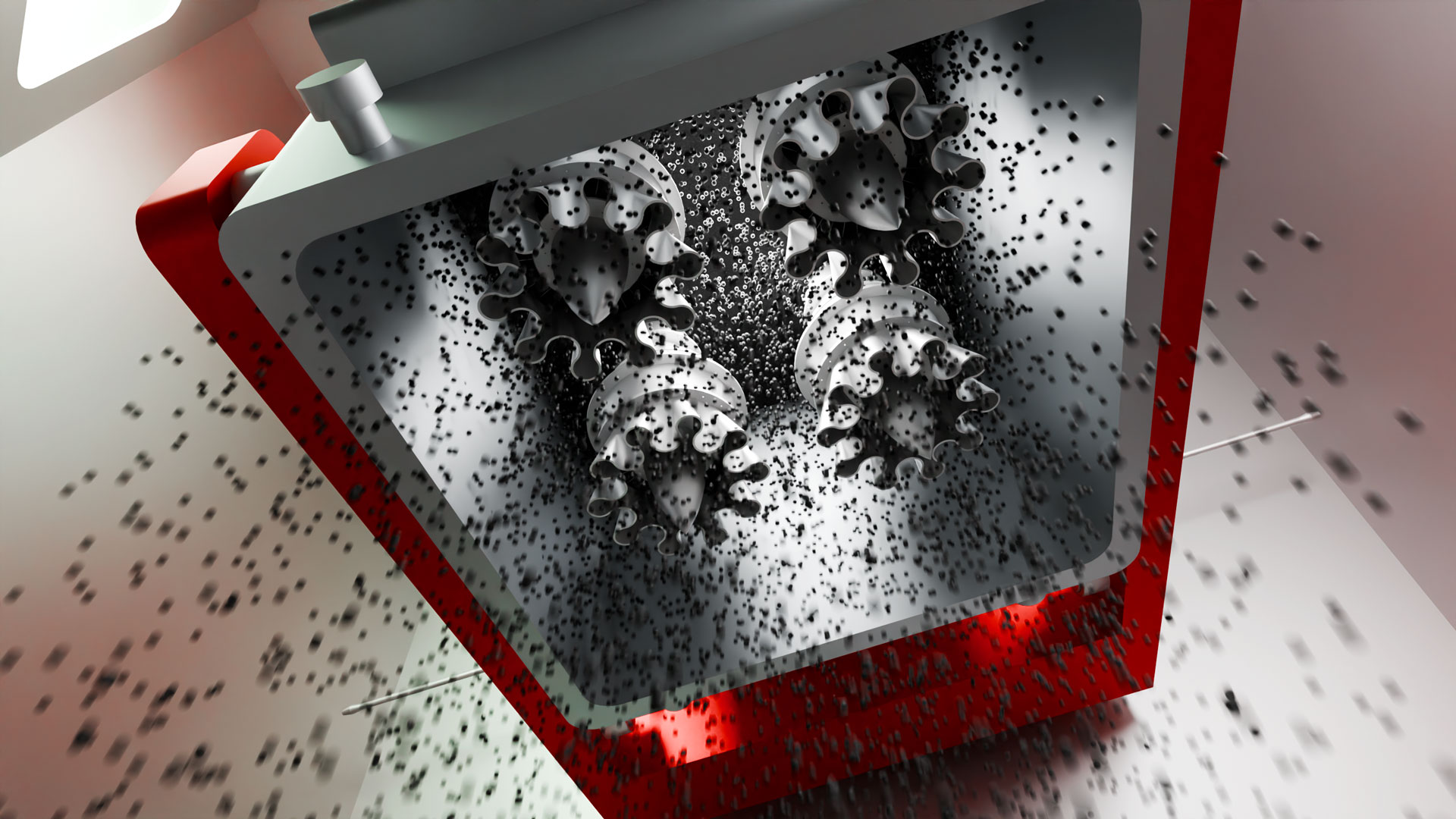
It targets one of the most used powder-bed systems in use which has a build volume of approximately 400 × 400 × 400 mm. A fully loaded build box of this size can contain hundreds of kilograms of metal powder. The MARSU4 is engineered to accommodate a total load of ~1100 kg (~2400 lbs), which covers the weight of the build box (~170 kg), a heavy metal build plate and printed parts, plus the powder fill that can easily sum up to 700–900 kg of powder. Handling this weight requires a robust mechanical design and careful attention to the system’s center of gravity and stability during operation. The machine’s footprint is compact for its capability fitting within the typical floor space constraints. For loading such heavy builds, the station is designed to be accessible by a forklift or crane. In fact, the MARSU4 features an automatic top-lifting door on the chamber, allowing overhead crane loading of the build frame when needed, and a front door with a large viewing window for normal access.
Like other MARS-series machines, it also provides a sealed, explosion-proof working chamber with inert gas purging capabilities. Before any powder is disturbed, the interior is purged with argon or nitrogen gas to reduce oxygen levels below 2% creating an oxygen-starved environment that “virtually eliminates explosion risk” for reactive powders. This process takes approximately 15 minutes, after which the atmosphere inside is safe for automated handling of even pyrophoric metal powders (e.g. titanium or aluminum alloys). The rigid stainless-steel chamber, along with integrated HEPA13 filtration, ensures that no dust escapes to the environment any vented gases are filtered so that only clean air is released. The machine is being built to comply with ATEX directives for handling explosive dusts, and is designed to be UL-certifiable.
Unpacking Process
The MARSU4 automates the unpacking sequence that would otherwise be done manually, orchestrating several steps into a seamless operation:
- Load and Lock: The sealed build frame (straight from the printer, with a lid bolted on to contain powder) is placed onto the machines’s docking station. This is done using a crane due to the weight and positioning. The docking mechanism automatically latches onto the build frame securely and an interface is connected for controlled rotation.
- Inert Gas Purge: Once the build frame is in place, the chamber doors are closed and the system begins purging with inert gas. Over ~15 minutes, oxygen is displaced from the chamber. The internal O₂ sensors monitor the level until it falls below the safe threshold (about 2% O₂). Only then will the system proceed, ensuring that the reactive powder can be handled without risk of ignition.
- Lid Removal under inert atmosphere: After the purging cycle is completed and a safe inert atmosphere is established inside the working chamber, the build box lid is removed inside the enclosed environment before the unpacking process begins. Performing lid removal under inert conditions ensures that reactive or hot powders are never exposed to ambient air and that dust remains fully contained within the system.
- Powder Unpacking (Rotation & Vibration): The core of the process involves getting the powder out of the build box. The servo-driven swivel arm now rotates the build frame 180° upside-down, effectively inverting the box. Thanks to gravity, a large portion of the loose powder immediately falls out into the machine’s collection hopper below. To tackle powder that clings or is trapped in complex part geometries, the system employs vibration, a frequency-controlled pneumatic vibrator agitates the build frame and parts, shaking loose powder from crevices and overhangs. The combination of inversion plus vibration ensures that over 90% of the powder is removed from the parts.
- Powder Collection & Conveyance: The powder shaken out during unpacking is funneled into the collection hopper at the bottom of the chamber. From here, the machine uses a screw conveyor system to transport the powder out of the machine. This design decision was made because the powder may be quite hot (around 200 °C) immediately after printing, which makes pneumatic vacuum conveying less suitable. The screw conveyor can handle hot powder and transfers it to an external powder storage tank provided by the user. In this case, the external tank is purged with inert gas as well, and connected via a valve. Once the connection is open, the screw conveyor runs continuously to move powder into the vessel. The system can be programmed to stop automatically when the vessel’s load cell indicates that powder flow has ceased, or the operator can stop it manually.
- Restoration and Unload: After the powder is evacuated, the build frame is rotated back to its upright home position and the chamber is gradually vented with air. Once the oxygen level is back to normal, the system unlocks the chamber doors. The operator can then remove the build frame. The unpacked part is ready for further post-processing. Meanwhile, the collected powder can be reclaimed from the external hopper for recycling or safe disposal.
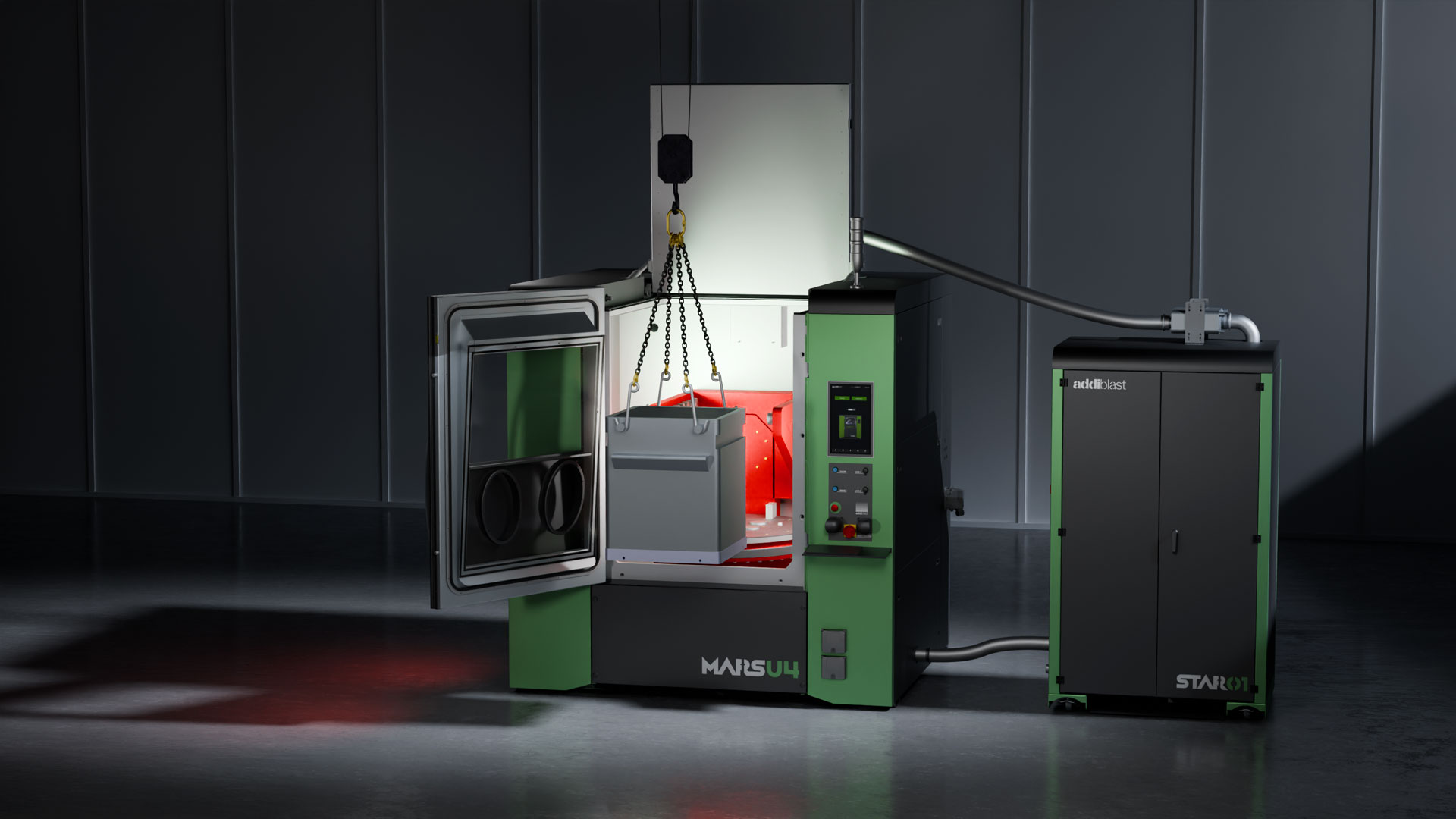
This entire automated cycle is targeted to take roughly 30 minutes. The actual powder-removal (rotation and vibration) is only a part of that, a significant portion is the inert gas purging and subsequent ventilating steps. Even so, 30 minutes is a dramatic improvement over manual cleaning of a similar build, which could take many hours and still leave powder behind. Automation not only speeds up the process (by as much as 90% in some cases ) but also ensures consistency where every cycle follows the same recipe, yielding a reliably cleaned result regardless of operator skill. This repeatability is crucial for industrial AM users who need to meet qualification standards for safety-critical parts.
Key Features of MARSU4
The MARSU4 incorporates several advanced features to meet the demanding requirements of large-scale metal AM unpacking:
- At the heart of the machine is a heavy-duty servo motor and swivel arm assembly capable of rotating a 1+ ton load with precision. It offers a 180° tilt (inversion) to empty powder out of the build box. The motion is smooth and controlled to avoid jolting (which protects the part from damage). This arm includes the docking station that interfaces with the build frame and uses an automatic locking mechanism.
- All electrical and mechanical components inside the chamber are designed to meet ATEX Zone 21 standards (for dust explosivity) or equivalent, meaning they won’t ignite a powder cloud. The entire unit is a sealed, dust-tight steel enclosure with robust door locks and seals. A HEPA13 exhaust filter is fitted to the ventilation system so that when the chamber is vented or if any slight positive pressure occurs, no fine powder escapes unfiltered. These design elements align with best practices for combustible dust handling, providing a high level of safety for both operators and the facility.
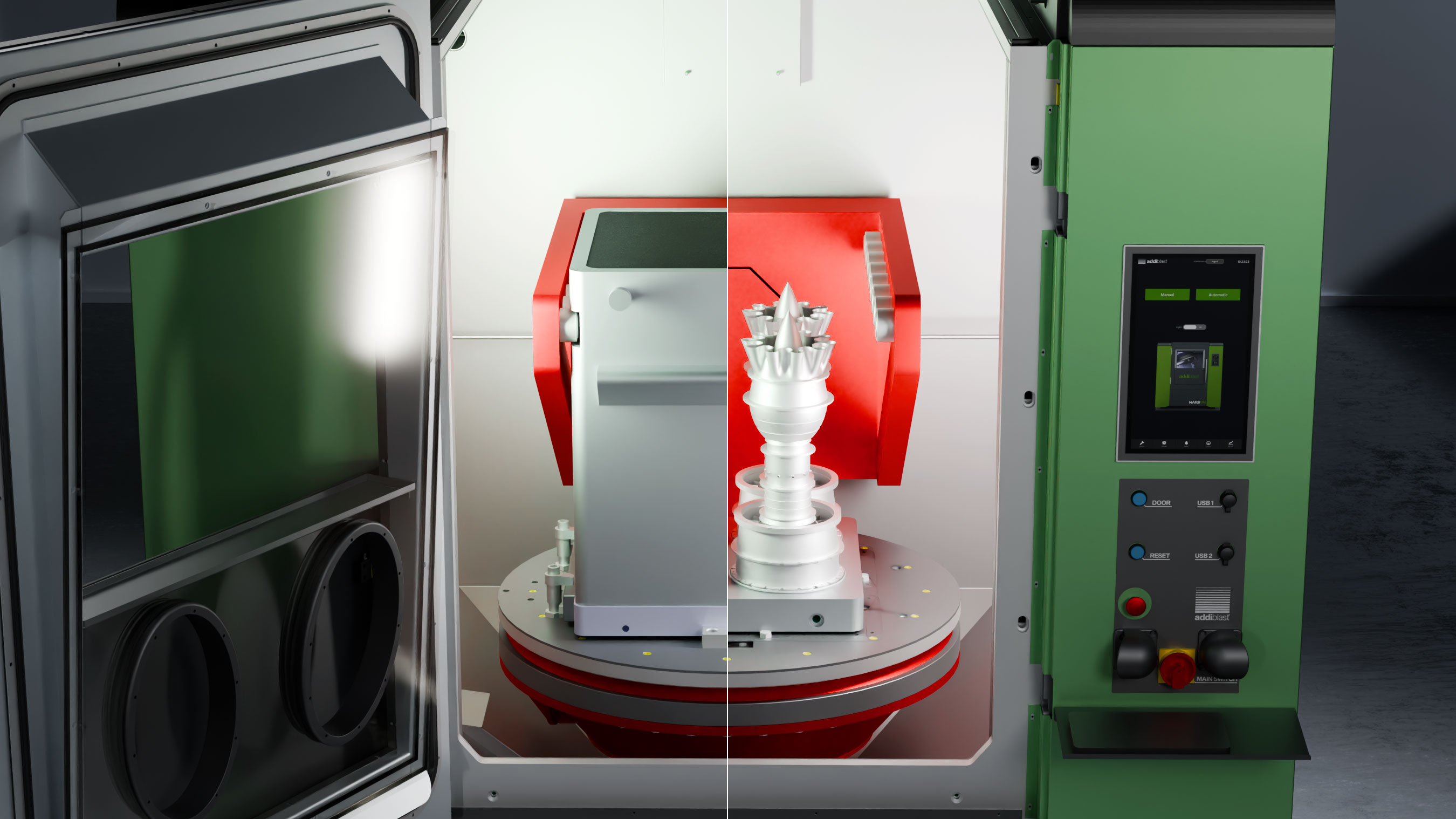
- Operated via a 12-inch color touch-screen panel PC, running a Windows-based interface that Addiblast provides on its machines. Operators can switch between manual mode (for maintenance or setup) and automatic mode where a programmed sequence runs the entire unpacking routine. The interface shows real-time status and allows parameter adjustments. The control system is built on a PLC ensuring reliability and safety interlocks. For instance, the doors remain electronically locked whenever the chamber is oxygen-poor or when any part of the sequence is in progress, preventing accidental opening.
Impact and Outlook
Although the MARSU4 is still in the concept/proposal stage, its development marks an important step forward for automated post-processing in metal AM. By addressing the specific requirements of a leading aerospace company’s AM workflow, Addiblast has demonstrated the feasibility of unattended unpacking for very large and heavy builds. The benefits of such a system are significant with improved operator safety, faster turnaround times between prints, and more efficient powder recovery for reuse.
Just as the printing process itself is automated, the industry is moving to automate the “dirty work” that comes afterward. Fully automated depowdering/unpacking stations, once considered experimental, are quickly becoming viable and even necessary for high-volume or large-format AM production. If you need more information do not hesitate to contact us.