
Metal Depowdering Solutions for Additive Manufacturing

Efficient Post-Processing for Metal 3D Printed Parts
Addiblast specializes in metal depowdering and post-processing solutions for industrial 3D printing. Our MARS series (Metal Additive Removal System) machines provide both automated depowdering and manual cleaning options to safely and efficiently remove residual powder from 3D printed metal parts. Effective depowdering is critical for making additive manufactured parts functional and reliable in end-use applications, which is why our solutions focus on thoroughness, safety, and repeatable results.
Designed to meet the needs of demanding industries – from aerospace and space exploration to medical devices and automotive manufacturing – these metal powder removal systems ensure that every particle of powder is cleared, leaving parts clean, safe, and ready for further processing.

Solving Depowdering Challenges
In additive manufacturing, printing the part is only half the story. Excess powder must be removed safely, consistently, and efficiently. Manual cleaning is slow, inconsistent, and labor-intensive.
Addiblast develops automated depowdering and post-processing systems like MARS03, that transform this bottleneck into a repeatable, reliable process helping manufacturers move from prototypes to true series production.
The Challenge: Complex Parts & Residual Powder
In powder-bed metal 3D printing processes (such as SLM/DMLS, EBM, and binder jetting), parts are produced surrounded by fine metal powder. When printing is complete, the part is encapsulated in unused powder – including powder trapped in internal channels, lattice structures, and other hard-to-reach cavities. Removing this powder is a challenging post-processing step. Manual depowdering methods (e.g. brushing, air-blowing, vacuuming, or even tapping/hammering the part) are often inefficient and risky.
Fine metal powders (like titanium or aluminum) can be health hazardous if inhaled and are combustible, creating an explosion risk when dispersed in air. In complex geometries, manual cleaning may leave residues behind, potentially causing part failures or contamination in subsequent steps (heat treatment, surface finishing, etc.).
Furthermore, manual processes are time-consuming and results can vary widely between operators. These challenges make it clear that removing powder thoroughly and safely is essential for quality and for compliance with industry safety standards. Addiblast addresses these challenges by providing purpose-built depowdering systems that ensure consistent, complete powder removal even for the most intricate additive-manufactured components.
Addiblast MARS Series Depowdering Systems
To solve the powder removal challenge, Addiblast offers the MARS series – a range of metal depowdering systems engineered for different part sizes, weights, and production volumes. Each MARS machine is a sealed depowdering station equipped with specialized features to dislodge and collect excess powder from printed parts. By containing the process within a closed cabinet, our systems protect the operator and environment from airborne dust while enabling efficient recovery of powder for reuse. All MARS models share common design principles of safety, efficiency, and precision:
-
Safety: Rigid steel cabinets with explosion-proof designs and HEPA-filtered ventilation provide a high degree of protection from combustible dust and toxic particles. An inert gas purging system is available to create an oxygen-reduced atmosphere, which is important for reactive powders like aluminum or titanium. This minimizes oxidation and virtually eliminates explosion risk by keeping oxygen levels low.
-
Efficiency: Automated motion (part rotation and vibration) is used in our systems to free powder from every nook and cranny of the part. This automation dramatically reduces cleaning time (up to 90% faster than purely manual cleaning) while ensuring no powder is missed . Powder is collected at the bottom of the chamber or in dedicated bins, preventing any spread of powder to the workshop and simplifying disposal or recycling.
-
Precision & Consistency: Our depowdering process is gentle on the parts yet thorough on powder. Controlled multi-axis rotation (in automated models) allows even fine internal channels to be cleared of powder by repeatedly reorienting the part so gravity can help drain out powder, assisted by targeted vibration and air blasts. The result is a reproducible cleaning result for every build – an important factor for qualifying parts in serial production. Unlike manual cleaning, which can vary, automated depowdering delivers the same high level of cleanliness every cycle.
With these advantages, Addiblast’s MARS series ensures a safe, closed-loop depowdering process that can be integrated into any metal additive manufacturing workflow. We offer both manual depowdering cabinets for hands-on operation and fully automated depowdering machines for higher throughput and automation. The MARS lineup spans from compact units for small intricate parts to very large systems that handle parts up to 1 cubic meter in size and 1100 kg in weight, and we can do even larger if requested.

Manual Depowdering Systems – MARS01 & MARS02 BJP
Our manual depowdering units provide a hands-on approach to powder removal, ideal for smaller production runs, research labs, or highly delicate parts that benefit from human oversight. These systems still feature sealed, inert-capable cabinets to maintain safety while allowing the operator to manually access and clean the part.
MARS01 – Manual Depowdering Cabinet: The MARS01 is a compact manual depowdering system designed for safely cleaning small to medium-sized 3D printed parts by hand. The operator can manipulate the part inside a closed chamber (with glove ports or tools), ensuring all powder is brushed or vibrated off without exposure.
- Key features include an explosion-proof enclosure, an internal pneumatic vibration platform to help shake loose trapped powder, and a powder collection bin to capture removed material.
- Optional inert gas infusion is available for reactive materials, allowing the powder removal to occur in an oxygen-controlled environment.
- Specifications: Internal workspace up to approximately 300 × 300 × 400 mm, supporting parts up to ~150 kg. This system is well-suited for high-detail parts with complex support structures, where careful manual cleaning and support removal are needed.


MARS02 BJP – Binder Jet Depowdering Station: The MARS02 is a manual depowdering unit tailored for the binder jetting 3D printing process (BJP). Binder jet printers produce a entire build box filled with loose powder and printed parts, which requires removal of unbound powder post-print.
- The MARS02 BJP provides a larger cabinet to accommodate typical binder jet build boxes and includes features like a height-adjustable platform (with a lifting mechanism for Z-axis movement up to 300 mm) and a vibrating collection hopper for efficient powder recovery. Operators can safely remove powder from hard-to-access channels, cavities, and supports on binder jet parts using integrated air nozzles and manual tools. Dual safety interlocks and foot-pedal controls make operation ergonomic and secure.
- Optional upgrades include an enhanced powder recycling system and inert gas infusion for materials that require it.
- Specifications: Workspace dimensions are customizable to fit a given build box (e.g. ~750 × 450 × 250 mm), and the machine’s overall size is 1700 × 1600 × 2250 mm. The MARS02 is ideal for industries utilizing binder jet printing, ensuring that even fine powder is thoroughly removed from intricate parts before sintering or further processing.
Automated Depowdering Systems – MARS03, MARS04, MARS05
For production environments and large parts, Addiblast offers automated depowdering machines that execute the powder removal process with minimal manual intervention. These systems use motorized rotation, vibration, and programmed cycles to clean parts efficiently and consistently, which is crucial for industrial-scale additive manufacturing. All automated MARS units are enclosed, negative-pressure cabinets with built-in powder collection and optional inert atmosphere control. They differ primarily in the size of parts they can handle and the range of motion provided:
MARS03 – Automated Depowdering for Medium Parts: The MARS03 is a fully automated depowdering system designed for medium-sized metal AM parts. It features a servo-driven swivel arm that holds the build plate or part and rotates it up to 210°, allowing powder to flow out from internal cavities. Combined with pneumatic vibration and directed air blasts, the MARS03 effectively dislodges powder from complex geometries without manual aid.
- Key features: explosion-proof cabinet, automated rotation/vibration, and a powder collection bin that captures powder for easy handling.
- Options include inert gas purging to create a safe low-oxygen environment and smart measurement analytics to monitor the depowdering process (for instance, sensors to detect when powder has fully evacuated).
- Specifications: Accommodates parts up to ~400 × 400 × 400 mm in size, with a maximum part weight of ~200 kg. This makes MARS03 suitable for most mid-size printer outputs and functional prototypes in aerospace, automotive, and medical industries.


MARS04 – Automated Depowdering for Large Parts: The MARS04 is a larger-format automated depowdering system built to handle large, heavy metal parts or dense builds with multiple components. It is equipped with an endless two-axis rotation mechanism, meaning it can continuously rotate the part 360° on two axes. This full range of motion ensures that even very complex or tall parts can be flipped and turned in any orientation needed to evacuate trapped powder. The MARS04 also includes convenient pneumatic top-lifting doors for crane loading, so heavy parts (up to 900 kg) can be inserted and removed easily.
- Key features: fully automated operation with programmable rotation sequences, robust explosion-proof design, and compatibility with large industrial printers’ build volumes.
- Specifications: Internal chamber volume supports parts roughly up to 600 × 600 × 1000 mm, with a max load of ~900 kg. Optional inert gas system and advanced powder removal modules are available, similar to MARS03.
The MARS04 is ideal for aerospace and automotive components such as engine parts or structural prototypes that demand thorough depowdering due to their size and complexity.
MARS05 – Automated Depowdering for Extra-Large Parts: The MARS05 is Addiblast’s largest depowdering system, engineered for extremely large and heavy 3D printed metal components. It accommodates parts up to 1000 × 1000 × 1000 mm in size and a weight of 1100 kg (or even more with custom configurations). The MARS05 uses a powerful servo-driven swivel arm (210° rotation) and high-torque vibration to handle massive parts such as rocket engine sections, satellite components, or industrial molds. Despite the size, it maintains fine control to protect delicate features during cleaning.
- Key features: automated multi-axis powder removal, heavy-duty construction with pneumatic lift doors (for overhead crane access), and an explosion-proof sealed chamber. An inert gas infusion system can be integrated to manage reactive or large volumes of powder safely.
- Specifications: Machine dimensions ~3100 × 2300 × 3200 mm; internal workspace ~1 m³; standard load capacity 1100 kg
- Customization: If your application requires even larger capacities, Addiblast can provide tailored modifications (the 1100 kg load limit can be increased on request).
The MARS05 opens the possibility to depowder very large additive builds that were previously impractical to clean manually, addressing the needs of the space industry and energy sector (for example, 3D printed turbine parts or reactor components).

Custom-Built Depowdering Solutions
In addition to our standard MARS lineup, Addiblast offers custom-made depowdering systems upon request. We understand that certain applications may have unique requirements – such as oversized build volumes, special material handling needs, or integration with proprietary production lines. Our engineering team can collaborate with you to design a customized depowdering solution that meets those specifications. This could involve scaling up one of our existing models, adding extra degrees of motion, specialized nozzles or sensors, or creating a hybrid manual/automated system suited to your workflow. For example, if you need to depowder parts larger or heavier than what the MARS05 supports, or you require an automated depowdering station built into a glovebox line or clean room, we can develop a solution to fit. Custom depowdering systems ensure that no matter how unusual or advanced your metal AM project is, you can perform effective powder removal with the same level of safety and efficiency that all Addiblast products provide. Reach out to us with your requirements – we’re happy to advise on a tailored system.
Integration with Post-Processing Workflow
Depowdering is typically the first of several post-processing steps in metal additive manufacturing. Addiblast’s solutions are designed to integrate seamlessly into a full AM post-processing workflow to streamline production. After depowdering, recovered powder can be transferred to a powder recycling or sieving system to be cleaned and prepared for reuse in future prints. Our STAR series systems (Addiblast STAR – 3D Print Powder Recycling) provide automated powder recycling and conditioning, creating a closed-loop powder cycle. This means that once MARS depowdering is complete, the extracted powder can be sieved, refined, and returned to your printer’s feedstock, reducing waste and material cost.

Similarly, once parts are depowdered, they often require surface finishing (such as removing roughness or minor artifacts from the print process). For that, Addiblast offers the BAM series of blasting cabinets (Addiblast BAM – 3D Print Surface Treatment) to perform precise sandblasting or shot peening on 3D printed parts, both metal and plastic. By using Addiblast depowdering, recycling, and surface treatment solutions together, manufacturers can establish a comprehensive post-processing line: first automated depowdering, then powder recycling, then surface finishing – all in a safe, efficient, and automated manner. This integrated approach helps maintain a clean production environment (no loose powder contamination) and ensures each printed part moves smoothly from one step to the next. Our equipment can be configured to work in tandem, for example, with material handling systems moving parts from the depowdering unit to the next station, enabling a semi- or fully-automated factory setup. The result is a closed-loop additive manufacturing workflow where powder goes in, and finished, depowdered parts come out, with minimal operator intervention and maximum safety.
Applications in Key Industries
Metal depowdering is a crucial step across all industries that use metal additive manufacturing, especially those with strict quality and safety standards. Addiblast caters to a broad spectrum of industries, and our depowdering solutions have specific benefits for each:
-
Aerospace & Space: The aerospace and space industries are pioneering users of metal 3D printing for components like rocket engine parts, satellite brackets, fuel manifolds, and heat exchangers. These parts often have complex internal cooling channels and lattices that must be completely free of residual powder to function properly and safely. Automated depowdering in an inert environment is especially valuable here, since many aerospace alloys (e.g. titanium, aluminum) are reactive and powders can be pyrophoric. Addiblast’s MARS systems ensure thorough cleaning of these intricate geometries and offer inert gas safety measures, which helps aerospace manufacturers meet stringent quality control and safety requirements. Large systems like MARS04 and MARS05 can accommodate sizable rocket components or aircraft parts, making them suitable for space launch companies and aviation firms moving toward large-format AM. By delivering consistent, validated cleaning of parts, our depowdering solutions also support the certification process for critical aerospace components.

-
Medical & Dental: Medical industries use metal AM to produce items such as orthopedic implants, spinal cages, surgical tools, and dental restorations. For medical parts, any leftover powder is unacceptable because it could be released in the human body or interfere with sterilization. Depowdering is essential to meeting the biocompatibility and cleanliness standards for implants and devices. Addiblast depowdering machines enable gentle yet thorough cleaning of fine lattices and porous structures often found in medical implants (for example, acetabular cups with porous surfaces, or dental mesh structures). The reproducibility of an automated system ensures every implant is cleaned to the same high standard, supporting regulatory compliance (e.g. FDA requirements). Moreover, our inert gas option can prevent oxidation of sensitive alloys like titanium alloy or cobalt-chrome during cleaning, preserving the part’s surface chemistry. Medical manufacturers also benefit from the contained powder handling – protecting staff from exposure to potentially toxic powder (such as cobalt-chrome dust) and keeping the facility clean. Whether it’s a few custom implants via MARS01 or a batch of hundreds of dental parts in a larger machine, Addiblast helps the medical sector achieve safe, clean 3D printed products ready for implantation or use.
-
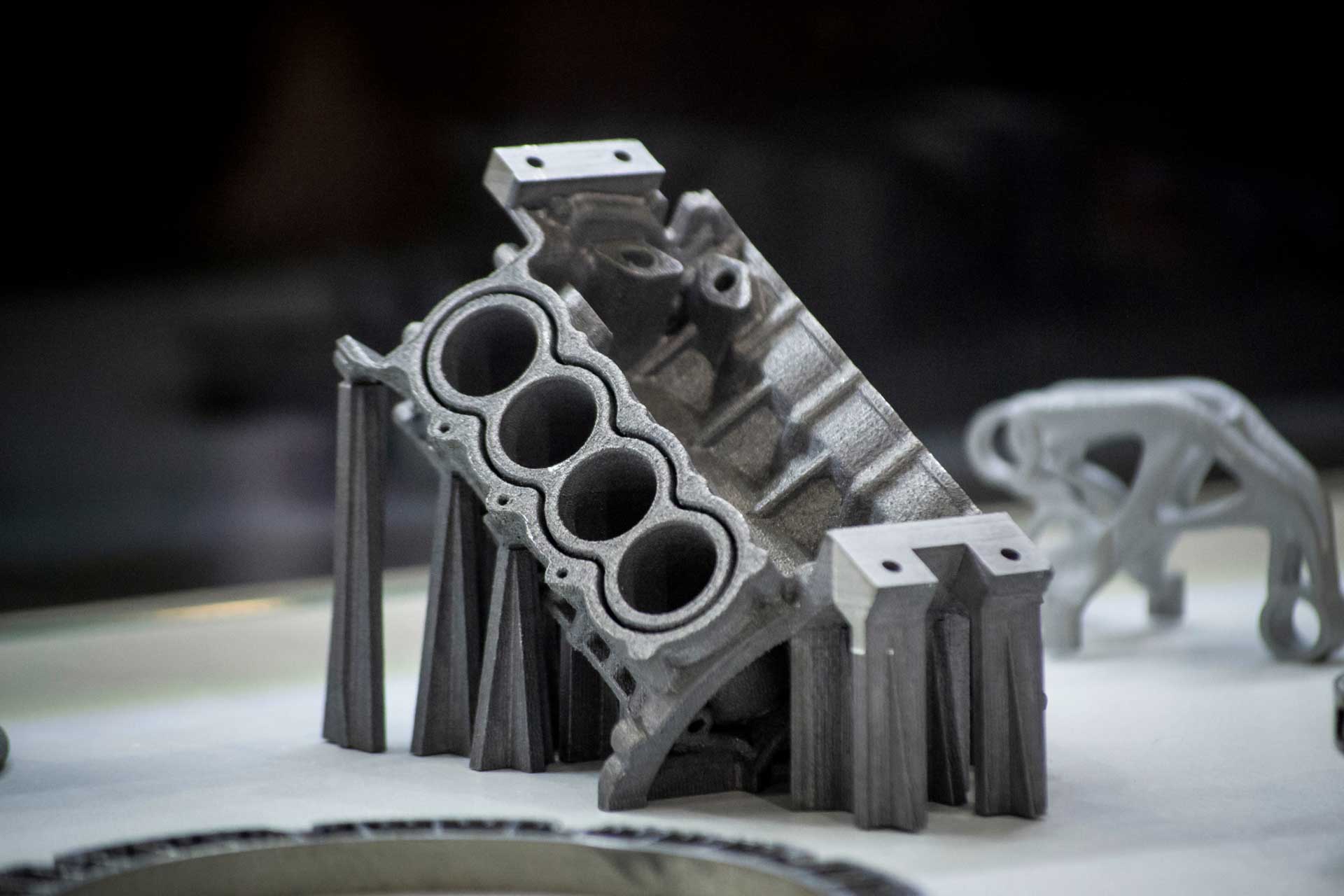
Automotive & Industrial Manufacturing: The automotive industry and other heavy industrial sectors (oil & gas, tooling, general manufacturing) are increasingly adopting metal 3D printing for rapid prototyping, tooling inserts with conformal cooling, and even end-use parts. These applications demand a cost-effective post-processing solution because throughput and productivity are key concerns. Our automated depowdering systems significantly reduce manual labor and cycle times, which aligns well with automotive production goals. For example, a service bureau printing metal parts for automotive clients can use MARS03 or MARS04 to quickly clean parts overnight, improving turnaround time. The ability to reclaim and reuse expensive powders (such as Inconel or stainless steel) via integrated recycling also offers a cost advantage. Industrial users appreciate the robust build of Addiblast machines and the fact that they can handle large, heavy parts like tooling dies or pump impellers that might be printed in metal. By ensuring every channel and hole is free of powder, our depowdering solutions help these parts perform as designed (e.g. ensuring a 3D printed mold with cooling channels functions efficiently). Additionally, for factory environments, having a closed depowdering system improves shop safety and housekeeping, which is a non-trivial benefit for industrial facility managers.
-
Energy & Turbomachinery: In the energy sector (power generation, oil and gas, etc.), metal AM is used for components like turbine blades, fuel nozzles, heat exchangers, and pumps. These parts often have extremely complex internal geometries optimized for performance (cooling or flow) and are made in reactive alloys (nickel superalloys, titanium, etc.). Proper depowdering is crucial to remove any blockage (imagine a cooling channel in a turbine blade that still contains powder – it could cause the blade to overheat or the powder could sinter during heat treatment). Addiblast’s larger MARS units are capable of processing heavy, complex parts typical in the energy industry. The inert atmosphere feature is a major plus when working with materials like titanium aluminides or fine titanium powders used in some aerospace-energy crossover applications. Energy companies can also benefit from the data and analytics (optional smart monitoring) in our systems to ensure that each part is cleaned to spec, which is valuable for safety-critical components. Moreover, with the high cost of many specialty powders, being able to recover and recycle powder from each build (via our STAR system post-depowdering) improves the economics of AM in these industries.
In summary, whether it’s a satellite component, a hip implant, a fuel injector, or a turbine rotor, Addiblast’s metal depowdering solutions provide the reliability and performance needed to support additive manufacturing at an industrial scale. We help companies in aerospace, space, medical, automotive, energy, and beyond achieve a smooth transition from 3D printing to a finished part by removing the last grain of powder.
Frequently Asked Questions - Metal Depowdering
Depowdering is the process of removing the excess powder from a 3D printed part after the build is finished. In metal additive manufacturing (particularly powder bed fusion or binder jetting), the printed component is surrounded by and filled with unused metal powder. Depowdering involves cleaning out all that powder – from the surface and from any internal cavities – so that the part is powder-free and ready for further post-processing. It’s a critical step right after printing, because parts must be completely powder-free for safety and functionality (loose powder can impede moving parts, affect thermal treatments, or pose health hazards). Metal depowdering can be done manually or with specialized depowdering machines like Addiblast’s MARS series.
Depowdering is necessary to make additively manufactured parts functional and safe. When a part comes out of a powder bed 3D printer, fine powder is clinging to every surface and packed into any hollow sections. If that powder isn’t removed, the part might not perform as designed – for example, cooling channels won’t allow fluid flow, or a loose powder grain could later dislodge and damage machinery. Additionally, leftover powder can cause issues in downstream processes: it might contaminate coating or heat treatment processes, and it definitely prevents accurate inspection of the part’s geometry. From a safety perspective, loose metal powder is a hazard (it’s potentially explosive and harmful to handle). Therefore, depowdering ensures the part meets quality standards, is safe to handle, and is ready for post-processing steps like heat treatment, Hot Isostatic Pressing (HIP), machining, or surface finishing. It is an indispensable step in the post-processing of metal 3D printed parts.
An automated depowdering machine like the Addiblast MARS series automates the powder removal through controlled motion and cleaning mechanisms inside a sealed chamber. Typically, the printed part (often still attached to its build plate) is mounted inside the machine. The system then executes a programmed sequence where the part is rotated on multiple axes (to let powder fall out of channels and overhangs) and subjected to vibrations and directed air blasts. This combination loosens and dislodges powder from every surface of the part. The removed powder falls into a collection bin or through a sieve at the bottom of the chamber. High-efficiency filters capture any airborne dust to prevent emissions. All of this happens inside a closed cabinet, often under inert gas if required, so the process is safe and contained. The operator simply initiates the cycle and, after completion, retrieves a fully depowdered part. Automated depowdering systems typically have presets or adjustable settings to handle different part geometries and powder types. The outcome is a consistent, thorough cleaning without the need for manual scraping or brushing.
The main difference is in how the powder removal is carried out and the level of human involvement. In manual depowdering, an operator physically cleans the part, usually by blasting air or brushing while the part is in a safety enclosure. The operator might use glove ports on a cabinet to handle the part and direct the cleaning tools. Manual systems (like Addiblast’s MARS01/MARS02) give a lot of control and are suitable for small batches or very delicate tasks, but they rely on the operator’s thoroughness and can be slow for complex parts. Automated depowdering uses a machine to do the cleaning automatically – the part is rotated and vibrated by the machine, rather than by hand. The operator’s role is mainly to set up the part and start the process. Automated systems (MARS03/04/05) are much faster and more repeatable than manual cleaning. They also tend to be safer, since the operator is not directly exposed to the powder during cleaning. However, automated machines are larger and typically a bigger investment. In practice, many companies use a combination: e.g., automated depowdering for the bulk of the powder removal, followed by a quick manual touch-up if any stubborn powder remains. Addiblast offers both types, so users can choose based on their workflow and volume of parts.
Choosing the right depowdering solution depends on several factors: part size, part complexity, production volume, material, and budget. First, consider the maximum size and weight of the parts or build plates you’ll be cleaning – this will narrow down which models can accommodate your needs (e.g., very large aerospace parts might require a MARS05, whereas small dental parts could be handled in a MARS01). Next, think about throughput: if you are producing many builds a week or aim to automate production, an automated depowdering machine is likely more suitable to save time and labor. If you only print occasionally or have highly delicate parts, a manual depowdering cabinet might suffice. Also consider the materials you use: reactive metal powders will benefit from a system with an inert gas option for safety. Budget and available space are practical considerations – automated systems offer great efficiency but are a higher initial investment and have a larger footprint. We encourage discussing with the Addiblast team; we can assess your specific use-case (industry, part specs, etc.) and recommend the optimal setup. Sometimes the answer is a combination, for example: using an automated system for general cleaning and a small manual station for fine detail work. With our range from MARS01 through MARS05, we have solutions for small labs up to full industrial production lines.
Yes, depowdering systems like Addiblast’s MARS series are designed with extensive safety features to handle metal powder safely. Explosion safety is a top priority: our depowdering cabinets are built to be explosion-proof (meeting ATEX standards for equipment in explosive atmospheres) and include features like pressure relief panels or flame arrestors. The option to use an inert gas purge (filling the chamber with argon or nitrogen) further eliminates the risk of dust explosion by removing oxygen. Another safety aspect is operator protection – during depowdering the chamber is sealed, and any vented air passes through filters (e.g. HEPA filters) to trap fine particulate. This prevents the operator from inhaling toxic metal dust. The machines also have interlock systems: doors cannot be opened until the cycle is complete and the interior is safe (e.g., dust settled and any inert gas flushed out). Many systems include sensors to monitor the oxygen level (if inerting) or the pressure/vacuum level to ensure proper containment. Lastly, ergonomic considerations (like foot pedal controls, lifting aids for heavy parts, good visibility inside the chamber via windows and interior lighting) contribute to safe and comfortable operation. By using a dedicated depowdering system instead of a makeshift manual process, you significantly reduce health hazards and fire risks associated with metal powder handling, making your AM process much safer overall.
Inert gas infusion refers to the practice of flooding the depowdering chamber with an inert gas (such as argon or nitrogen) to displace oxygen during the powder removal process. This creates an atmosphere inside the machine that will not support combustion. Inerting is important when working with reactive or combustible powders – for example, titanium and aluminum powders can form explosive dust clouds if exposed to air and an ignition source. By keeping oxygen levels low (typically below ~5%), inert gas infusion greatly reduces explosion risk and prevents unwanted oxidation of the powder or the parts. Whether you need it depends on your materials and safety requirements. If you are depowdering aluminum, titanium, or similarly reactive alloys, it’s highly recommended to use an inert gas feature for safety. Many aerospace and medical companies, for instance, require inert atmosphere processing for those materials. If you only work with less reactive metals (like stainless steel or bronze) and have other explosion mitigation in place, you might depowder without inert gas. However, even in those cases, using inert gas can be an extra layer of safety and can help keep the metal powder pure (no oxidation or moisture from air). Addiblast offers inert gas infusion as an option on all MARS units – it’s essentially a built-in system to purge and replenish argon/nitrogen and monitor O₂ levels. We can advise based on your specific powder types whether this option is needed, but generally for any production environment dealing with fine metal powder, inerting is a best practice for peace of mind.
After depowdering, the removed powder is usually collected within the machine – typically in a bin or hopper at the bottom of the chamber, or in a connected powder recycling unit. In most cases, this powder can indeed be recycled and reused for future printing, as long as it is kept clean and within specifications. Addiblast strongly supports powder reuse to improve sustainability and cost-efficiency in additive manufacturing. We offer the STAR powder recycling system which can be connected to the depowdering process. When a depowdering cycle is finished, the collected powder can be automatically sieved (to remove any clumps or debris) and stored or mixed with fresh powder for the next build. By recycling the powder, manufacturers save on material costs and reduce waste. It’s important to note that recycled powder should be monitored for quality – over multiple reuses, powder particles can change shape or pick up contaminants. Our systems aim to preserve powder quality by gentle handling and options like inert atmosphere (to avoid oxidation). Many users find they can reuse a large percentage of the powder from each build, needing only to top up with a small amount of new powder to maintain consistent print quality. Any powder that is not reused should be disposed of safely according to material guidelines, but with a closed depowdering system, virtually all powder can be recovered without spillage, making recycling feasible and safe.
Automated depowdering is designed to be thorough yet gentle on parts. The goal is to remove powder without harming the part’s geometry or surface finish. Our MARS systems use controlled vibration and rotation – parameters can be tuned so that delicate features are not subjected to excessive force. The vibration frequencies and amplitudes are chosen to shake loose powder (which is typically much lighter and smaller) but not to cause plastic deformation of metal parts. Additionally, any air nozzles or powder removal tools inside are arranged to avoid direct impact on critical surfaces; they mainly blow powder out of cavities rather than sandblast the part. In practice, automated depowdering will not damage parts as long as the machine is used according to guidelines (e.g., securing the part properly, selecting appropriate settings). For extremely fragile structures (like a very thin lattice), one might use a lower intensity setting or do some manual finishing if needed. Our experience, and feedback from users, is that parts come out of the depowdering process intact and clean – often cleaner than could be achieved manually, and without scratches that manual tools might introduce. Before using any automated cycle, it’s okay to test on sample pieces to fine-tune the motion for your specific geometry. Addiblast can assist in optimizing the process for unusual or sensitive parts. Overall, automated depowdering is a non-destructive process and a standard practice for post-processing metal AM parts, including high-precision aerospace and medical components.
Yes – our depowdering systems are compatible with any additive manufacturing process that uses metal powder, where the end result requires powder removal. This includes laser powder bed fusion (also known as SLM or DMLS), electron beam melting (EBM), binder jetting, and even processes like cold spray or DED if there’s loose powder to remove (though powder bed processes are the main use-case). Essentially, if you have a 3D printed metal part that comes out surrounded by powder or has powder trapped in it, Addiblast MARS systems can help remove it. We design our fixtures and chambers to be flexible – for example, mounting points that can hold build plates from various printer manufacturers. Whether the powder is steel, titanium, nickel alloy, aluminum, or others, the removal mechanism (vibration + rotation) still applies. You might need different settings for, say, a heavy steel part versus a lightweight titanium lattice, but the same machine can do both. Additionally, our systems are material-agnostic: you can clean different powders in the same machine (with appropriate cleaning between if avoiding cross-contamination of materials). So, whether your metal parts were printed on a Renishaw, EOS, GE, 3D Systems, Trumpf, or any other metal AM machine, you can use Addiblast depowdering as part of your post-processing. We also serve the polymer powder bed market with other solutions, but the MARS series discussed here is focused on metal. In summary, all powder-bed metal 3D printing workflows require depowdering, and our solutions are equipped to handle them across the board.
Absolutely. Our systems are designed with industrial integration in mind. They can operate as standalone units or be part of an automated production line for additive manufacturing. For integration, we provide features such as forklift slots or crane hooks for moving heavy parts in/out (especially on MARS04/05 with overhead doors), and the ability to interface with robotic arms or conveyors if you want automated loading and unloading. The footprint and layout of the machines allow them to sit alongside printers and other post-processing stations. In a fully integrated AM cell, you might have a printer, then a depowdering unit, then a powder recycler, then a heat treatment furnace, etc., all in proximity – our equipment supports that flow. We also offer digital integration: for example, our upcoming Orbi depowdering software (an Addiblast software solution) can connect to a factory’s Manufacturing Execution System (MES) or IoT platform, enabling monitoring and control of the depowdering process remotely and logging data for traceability. This kind of digital integration is crucial for Industry 4.0 compliance and for running a smart factory. If needed, we can customize signal exchange (start/stop signals, safety interlocks) to work with your automation or enclosure. Many of our customers incorporate MARS depowdering units in glovebox lines or inert atmosphere rooms – and we provide the necessary ports and ducts for connecting to centralized argon supply or vacuum systems. Overall, Addiblast depowdering systems can be seamlessly integrated to create a lean, automated production workflow for additive manufacturing, ensuring that powder removal is not a bottleneck but a well-coordinated step in your process.
