

Metal Additive Manufacturing (AM) has unlocked new possibilities in aerospace, defense, medical, and other industries by enabling the 3D printing of complex metal parts. However, along with these opportunities comes a critical challenge: safety in handling and removing combustible metal powders. Fine metal powders such as titanium or aluminum that are widely used in powder bed fusion and other metal AM processes are highly combustible and can pose serious explosion and fire risks if not managed properly. Ensuring a safe depowdering process for metal AM is not just an operational concern but a non-negotiable priority for any facility. In this blog post, we delve into the safety challenges of combustible powder handling and the protocols to mitigate them. We’ll also highlight how Addiblast’s depowdering solutions, including the MARS series, provide a safe depowdering system for metal AM, using inert gas powder removal, strict electrostatic controls, and explosion-proof designs to meet the highest safety standards (ATEX, CE, NFPA). These technologies help reduce risk and ensure process reliability, which is especially vital for safety-critical sectors like aerospace and defense.
The Hazards of Combustible Metal Powders in AM
Metal AM processes typically use powders with particle sizes often in the tens of microns – about as fine as flour or confectioner’s sugar. Many metals in this form are highly combustible; in fact, most metals (and many plastics) used in AM are explosive in dust form. Reactive metals like titanium and aluminum are particularly notorious – they can oxidize rapidly and have a high “explosibility index,” meaning they burn extremely fast and hot if ignited. As one OSHA director starkly put it, “the fire and explosion hazards when working with titanium and aluminum are established, particularly when the materials are in powder form. Just as it’s easier to start a campfire with kindling than with logs, it’s easier for a metal fire to start when you’re working with metal powder that is as fine as confectioner’s sugar.” In other words, handling finely divided metal fuel greatly lowers the ignition threshold – turning a normally solid, stable metal into a potential tinder for fires and explosions.
The classic “fire triangle” (fuel, oxygen, ignition) expands to a “dust explosion pentagon” when combustible powder is dispersed in air and confined. All these elements must align for a dust explosion to occur. Fine metal powders provide plenty of fuel surface area, so controlling oxygen and ignition sources is critical to safety.

Under the right (or rather, wrong) conditions, a simple handling error can escalate into a dangerous flash fire or dust explosion. A dust explosion is essentially a rapid combustion of a fine particulate cloud within a confined space. Five elements are required – often illustrated by the explosion pentagon above: fuel (the combustible powder), oxidizer (air/oxygen), an ignition source (spark or heat), dispersion (the powder suspended as a dust cloud), and confinement. In a metal 3D printer or post-processing station, all these elements can inadvertently come together. For example, when powder is being removed from a build, particles can become airborne (dust cloud) in the presence of air (oxygen) and an ignition source. Ignition sources can range from an electrostatic discharge or electrical spark, to an open flame or even the high heat of a laser or hot surface. If such an ignition occurs in an open environment, it may cause a brief fire. But if it happens in a confined volume with a dense dust cloud, it can trigger a dust explosion in milliseconds – releasing intense heat and pressure.
Real-world incidents underscore these hazards. In one case, a metal AM service bureau in Massachusetts experienced a dust explosion while an operator was cleaning a printer in 2013. The worker suffered third-degree burns, and an OSHA investigation found that the facility had failed to eliminate ignition sources and was using electrical equipment not rated for hazardous locations. The powder (a titanium alloy) ignited when the operator was handling it in ambient air. Critically, the powder bed had been opened to the atmosphere, reintroducing oxygen, and no electrostatic discharge (ESD) controls or inert gas were in use at that moment. This incident illustrates how quickly things can go wrong if proper safeguards are absent: once the inert argon atmosphere of the printer was lost, the fine powder was exposed to air and a spark, leading to a flash fire/explosion. OSHA noted multiple safety lapses – from lack of grounding and ignition source control to inadequate training and failure to use explosion-proof equipment. Unfortunately, such accidents are not isolated. Dust safety databases have recorded incidents at 3D printing facilities (including a fatal explosion at a metal printer plant in 2023) caused by metal powder ignition. These underscore that combustible powder post-processing must be taken as seriously as the printing process itself.
Safety Protocols for Handling Combustible Metal Powders
The good news is that the risks of metal powder fires and explosions are well-understood, and there are proven protocols to manage them. By combining engineering controls, administrative procedures, and proper equipment, companies can safely handle and remove combustible powders as part of the metal AM workflow. Below we outline key safety measures and best practices:
-
Inert Gas Atmospheres (Oxygen Control): One of the most effective safeguards is to minimize oxygen exposure during powder handling. Metal AM machines themselves typically use inert gas (e.g. argon or nitrogen) to maintain oxygen levels below the powder’s limiting oxidant concentration during printing. This principle should extend to post-processing: perform powder removal in an inert atmosphere or glovebox whenever possible. Inerting prevents a combustible mixture from forming, so even if there is an ignition source, a fire/explosion cannot sustain. Many safe depowdering systems for metal AM include an inert gas purging feature that floods the chamber with argon to displace oxygen before the powder is disturbed. This is especially important for reactive powders like aluminum and titanium that can react explosively with air. ATEX safety guidelines in the EU explicitly recommend inerting to keep operations out of explosive atmospheres. In practice, this means using sealed enclosures with oxygen monitoring and purging capabilities for any powder removal or sieving steps. (In the earlier incident, insufficient inerting control during cleaning was a major factor, highlighting why a reliable inert gas powder removal setup is vital.)
-
Ignition Source Elimination and ESD Mitigation: All potential ignition sources must be controlled or removed wherever powders are present. This includes open flames and hot surfaces, but in an AM lab the more insidious risks are electrical sparks and static electricity. Electrostatic discharge (ESD) can easily ignite a cloud of fine metal dust, so measures should be in place to dissipate static. Ground all equipment and use conductive tools and surfaces in contact with powder. Operators should wear ESD-safe attire and avoid wool or synthetic clothing that can build static. Bonding and grounding straps, anti-static mats, and humidity control (to prevent the air from becoming too dry) are common strategies. The goal is to prevent any stray spark when brushing or vacuuming powders. All electrical equipment in the powder handling area – from vacuum cleaners to sensors – should be rated for use in hazardous locations (dust ignition-proof or intrinsically safe). In fact, standards like NFPA 484 and ATEX regulations require using appropriately classified electrical gear around combustible dust. For example, using a regular shop vacuum on metal powder is extremely dangerous due to static and motor sparks; instead, one should use an ATEX-compliant vacuum or wet inert vacuum designed for metal dust. A robust grounding and ESD control program is a fundamental safety pillar in any metal AM facility.
-
Dust Collection, Ventilation, and Housekeeping: Even with careful handling, some fine powder can escape into the work area (so-called fugitive dust). Good ventilation and dust collection systems are critical to capture this powder at the source and prevent it from accumulating. Post-processing stations often include dust extraction with high-efficiency (HEPA) filtration and possibly spark arrestors. Keeping the process under negative pressure (suction) ensures any leak is inward, not out into the room. Collected powder should be stored or disposed of following safety guidelines (e.g. in sealed containers, possibly inerted or kept wet for reactive metals). Housekeeping is equally important – regular cleaning of surfaces to prevent dust layers from building up on floors, ledges, or equipment. Even a thin layer of fine powder over a large area can fuel a secondary explosion if agitated by an initial blast. Thus, facilities should have cleaning schedules and use appropriate cleaning methods (vacuum or wet wipe; never dry sweeping of metal powders). In one case study, failure to regularly empty dust collectors and clean residues led to hazardous conditions and even the formation of thermite reactions between mixed metal powders. Proper maintenance of dust collectors (and using wet scrubbers for reactive metal dust) can mitigate these dangers. In summary: keep the work area tidy and never allow combustible powder to accumulate on surfaces.
-
ATEX Zoning and Explosion-Proof Equipment: In jurisdictions following ATEX guidelines (Europe and elsewhere), facilities are required to evaluate the areas where explosive dust atmospheres may occur and classify them into zones. For example, ATEX Zone 21 is an area where a combustible dust cloud is likely to occur occasionally during normal operation, and Zone 22 where such a cloud is not likely under normal conditions but could happen rarely. Powder handling stations or powder recycling units might be classified as Zone 21 or 22. Equipment used in those zones must be designed to not ignite the dust (meeting the ATEX 2014/34/EU equipment directive requirements). This typically means explosion-proof enclosures, intrinsically safe electronics, and strict control of surface temperatures. Even if you’re outside Europe, following ATEX zoning practices is wise for any combustible dust. Many leading 3D printing post-processing systems are ATEX-certified or built to comply, ensuring that their motors, lights, sensors, etc., won’t trigger an explosion. Additionally, passive explosion protection features may be employed: vent panels or pressure relief on enclosures to safely vent a deflagration, or suppression systems that detect and chemically quench a developing explosion. The need for such features depends on the risk assessment and whether the atmosphere can be fully inerted. The ultimate goal is that the equipment contains and mitigates any explosion so it doesn’t harm personnel or the facility – or, better yet, prevents the explosion altogether by design. When evaluating a depowdering or powder-processing machine, checking for ATEX/CE compliance and explosion-proof design is crucial for safe operation.
-
Operational Protocols, Training, and PPE: Technology alone isn’t enough – human factors play a big role in safety. All staff handling metal powders should be thoroughly trained on the hazards and proper procedures. A Dust Hazard Analysis (DHA) or risk assessment should be conducted for the AM process, and clear written procedures should be in place. For instance, there should be step-by-step protocols for loading/unloading build chambers, operating depowdering equipment, cleaning up spills, and emergency responses. It’s important that operators never bypass safety interlocks or “cheat” on procedures (such as opening a chamber before inerting is complete). Regular drills or reviews can keep awareness high. In terms of Personal Protective Equipment (PPE), anyone handling metal powder should wear non-sparking tools and attire: anti-static lab coats, conductive footwear, gloves, and eye protection at a minimum. For certain powders, flame-resistant (FR) clothing is recommended in case of a flash fire. Respiratory protection (dust mask or respirator) is also advised when there is any potential for airborne particles, to prevent inhalation of toxic metal particles. While good engineering controls (sealed systems) minimize the reliance on PPE, having the right protective gear as a last line of defense is still required. By fostering a safety-first culture and ensuring employees are educated and equipped, the risk of incidents can be drastically reduced.
Adhering to these protocols creates multiple layers of protection. No single measure is sufficient on its own – true safety comes from a combination of inert environment, ignition control, proper equipment design, and vigilant procedures (often referred to as the “Swiss cheese model” in safety, where layers of defense cover each other’s gaps). The end result should be that handling and removing metal powder becomes a routine, incident-free part of the workflow.
Standards and Regulations Shaping Powder Safety
Because of the inherent hazards, combustible dust safety in additive manufacturing is addressed by numerous industry standards and regulations. Compliance isn’t just about legal obligations – it provides a framework to systematically manage risks. Some key standards and guidelines include:
-
EU Machinery Directive & ATEX Directives: In the European Union, the Machinery Directive (2006/42/EC) mandates that machinery be designed to avoid explosion risks, whether from dust, vapor or gas. Manufacturers can achieve this either by containing any explosion or eliminating ignition sources (in accordance with ATEX requirements). The ATEX directives come in two parts: one for equipment (2014/34/EU, for manufacturers) and one for workplace safety (1999/92/EC, for employers). Under ATEX 1999/92/EC, employers must classify areas into zones (as discussed) and ensure controls are in place for each zone. An explosive atmosphere is defined as a mixture of air and flammable dust (or gas/vapor) that could propagate an explosion after ignition. If your AM powder handling area falls into Zone 21, for example, you must use category 2 equipment per ATEX (which can operate safely in that zone). This regulatory environment essentially requires that metal AM machines and post-processing equipment sold in the EU be engineered with explosion protection – through inerting, explosion-proof components, or both. When you see a depowdering unit with a “CE” mark and mention of ATEX, it indicates the system was built and tested to these strict safety standards. Always verify that any equipment used for combustible powders has appropriate certification or documentation of compliance.
-
NFPA Standards (USA) and International Codes: In the United States, there is no single “3D printing safety law,” but there are comprehensive NFPA (National Fire Protection Association) standards for combustible dust. NFPA 652 (Standard on the Fundamentals of Combustible Dust) and NFPA 654 (Standard for the Prevention of Fire and Dust Explosions from the Manufacturing, Processing, and Handling of Combustible Particulate Solids) provide general requirements for any industry handling dust. NFPA 484 is specifically focused on combustible metals – including aluminum, magnesium, and alloys – and outlines precautions for powder production, storage, and processing. These standards advise performing a Dust Hazard Analysis, using dust collection, explosion protection, and PPE, much like the protocols we described. In 2024, NFPA introduced NFPA 660, a new consolidated standard that combines several of the dust standards (including NFPA 484) into one document for easier reference. Following NFPA guidance, OSHA (Occupational Safety and Health Administration) can enforce safety under the General Duty Clause if a company is found negligent with combustible dust. For metal AM, OSHA has also published educational materials, and bodies like NIST and UL have been developing safety guidelines to help the burgeoning industry. Globally, ISO and IEC have standards relating to explosive atmospheres (e.g. the IEC 60079 series covers electrical apparatus in explosive atmospheres). By aligning with these standards, companies demonstrate due diligence in protecting workers and facilities. Moreover, major clients in aerospace and defense will often require evidence of such compliance (ATEX ratings, DHAs, etc.) from their manufacturing partners as part of quality and safety audits.
-
Environmental Health and Safety (EHS) Guidelines: Beyond formal standards, industry groups and government agencies have issued guidance for additive manufacturing safety. For instance, the U.S. Chemical Safety Board (CSB) and OSHA have highlighted additive manufacturing in their combustible dust outreach, given the incidents that have occurred. Best practice guides often recommend setting up designated ATEX-rated rooms or booths for powder handling, using inerting and exhaust for any process that can generate dust clouds, and storing metal powders in proper containers away from ignition sources. Companies are encouraged to develop comprehensive combustible dust management programs – including dust testing (to know K_st explosion severity and ignition sensitivity of their powders), rigorous training, emergency planning, and continuous improvement of safety measures. Achieving certifications like ISO 45001 (Occupational health and safety management) or using third-party audits can further strengthen an AM facility’s safety profile. The bottom line is that by following the layers of guidance available, the additive manufacturing industry can safely leverage metal powders without incident. As one OSHA regional administrator noted, those using metal powders must “incorporate basic safety measures into this 21st-century technology, so that it can grow without harming the employees”.
In summary, a combination of regulatory compliance and best practices forms the foundation of safe metal AM operations. The strict requirements in industries such as aerospace and defense reflect this: these sectors often mandate that suppliers follow standards like ATEX or NFPA to the letter. If you are 3D printing aerospace components with titanium powder, for example, you will likely need an ATEX-compliant 3D printing post-processing setup and documented procedures to satisfy both legal regulations and your client’s safety expectations. This is where specialized equipment can make a big difference – as it is built from the ground up to meet these safety challenges.
Addiblast’s Safety-Focused Depowdering Solutions (MARS Series)
When it comes to post-processing combustible powders, using purpose-built equipment is one of the smartest investments an AM operation can make. Addiblast has addressed these challenges head-on with its depowdering solutions – in particular, the MARS series (Metal Additive Removal System) automated depowdering stations. These systems were designed from the ground up for safe and efficient powder removal from 3D printed metal parts. By automating the depowdering step inside a controlled environment, the MARS systems drastically reduce the risk factors we discussed while also improving consistency and throughput.
What is MARS? The Addiblast MARS line is a family of depowdering machines ranging from the MARS01 (a manual depowdering glovebox station) up to MARS05 (an automated system for extra-large parts). All MARS units share a core philosophy: the powder removal process should be contained, controlled, and as hands-off as possible to maximize safety. Instead of an operator brushing powder off a part in open air, the MARS machines allow parts to be cleaned either inside a sealed chamber (with glove ports for manual assistance as needed) or through fully automated motion routines. The entire process takes place within a robust cabinet, preventing dust from escaping and protecting the operator.
Safe depowdering in action: Addiblast’s MARS01 depowdering cabinets provide an enclosed glovebox environment for manual powder removal. The operator can clean excess powder off printed parts using built-in gloves and tools, all while the combustible powder is contained in a sealed, negative-pressure chamber with proper filtration. This minimizes dust exposure, mess, and ignition risk.

The safety features of the MARS depowdering systems align perfectly with the protocols we described earlier. Some key aspects include:
-
Explosion-Proof, Enclosed Design: The MARS cabinets are engineered to be airtight and reinforced, essentially acting as an ATEX-rated safety enclosure for the powder removal process. All automated MARS units are enclosed, negative-pressure cabinets with built-in HEPA filtration and dust collection, so any stray powder is captured and the chamber pressure is kept slightly below ambient. This means even if a disturbance occurred, dust would not leak outward. The electronics and interior components are explosion-proof – motors, lights, valves and sensors are either located outside the powder area or designed to be non-ignitive. For example, the MARS03 and MARS04 feature a fully sealed motor drive for the rotating arm and have heavy-duty wiring that meets applicable standards. All this ensures compliance with ATEX/CE requirements for equipment used in Zone 21 environments (typical for a depowdering chamber). The cabinet even has safety interlocks: you cannot open the door until the system has rendered the environment safe (e.g. purged the chamber or settled the dust). The robust construction not only prevents explosions but is built to withstand one should it occur, keeping operators safe.
-
Inert Gas Purging for Reactive Powders: Addiblast’s depowdering systems offer an optional inert gas infusion system to create a low-oxygen atmosphere during cleaning. With a push of a button, the chamber can be purged with argon or nitrogen to reduce oxygen below the threshold at which titanium, aluminum, or other reactive metal powders could ignite. This inert gas powder removal mode is a game-changer for handling combustible powders – it essentially replicates the printer’s inert environment throughout the depowdering cycle. By processing parts in an oxygen-reduced atmosphere, MARS greatly reduces oxidation and safety hazards associated with reactive metals. Users have the flexibility to depowder in open-air mode for less reactive materials like stainless steel, or inert mode for the likes of Ti6Al4V or AlSi10Mg which have higher explosion risk. The system can include oxygen sensors to monitor O₂ levels and will alert if the atmosphere becomes unsafe, similar to how printers operate. This integration of inert atmosphere control means the MARS system can keep even the most flammable powders below their ignition risk, aligning with best practices recommended by ATEX and NFPA (and indeed fulfilling them).
-
Controlled Automated Powder Removal: Unlike manual cleaning, the MARS stations use automated mechanisms (motorized rotation, vibration, and directed air blasts) to dislodge powder from the printed parts. For example, MARS03 has a servo-driven swivel arm that can hold a build plate and rotate it past 180°, while vibrating and blowing air to shake loose powder. This automation is not just about productivity – it also improves safety by minimizing direct human contact with the powder. The machine performs the messy work inside the enclosed chamber. An operator might simply load the part, start the cycle, and then unload the cleaned part, never directly touching the powder. Fewer manual steps mean fewer opportunities for accidents (no more cloud of dust from aggressive brushing, for instance). Additionally, the controlled motions ensure a consistent, gentle cleaning that avoids creating unnecessary dust clouds. The systems are designed to avoid sparking – using pneumatic or electrically insulated actuators for moving parts within the chamber. By standardizing the depowdering process, MARS also reduces the likelihood of human error (a common factor in accidents). If needed, the operator can still intervene via built-in glove ports (for example, to gently brush a stubborn area), but this too happens within the sealed cabin, maintaining full containment.
-
Integrated Powder Collection and Recycling: Safety in powder handling extends to what happens after the powder is removed from the part. The MARS depowdering units funnel the extracted powder into a collection bin or directly into an integrated recycling system. The powder can be sieved and conditioned (removing agglomerates or debris) in an inert environment, and then transferred for reuse in the next build. Addiblast’s STAR series (3D print powder recycling solutions) can hook up to the MARS stations to automatically convey and recycle powder in a closed loop. This creates a seamless and safe powder workflow: from printer to MARS to recycling, the powder is always contained, greatly reducing exposure. By closing the loop, you avoid manual scooping or open-air transfers of powder, which are moments where spills or dust clouds could occur. It also ensures that unused powder is safely stored under inert conditions until needed again, lowering the risk of a powder sitting around exposed. From a safety standpoint, this integration means less handling and less waste – and from an economic standpoint, it improves powder reusability. (It’s worth noting that reducing powder waste is also a sustainability win and a cost saver, which many companies appreciate alongside the safety benefits.)
-
Monitoring and Analytics: The MARS systems come with smart features to monitor environmental conditions and usage stats in real time. They track things like the humidity and temperature inside the chamber, the inert gas pressure, and even vibration levels during cleaning. Why is this a safety feature? For one, maintaining a bit of humidity can help dissipate static (too-dry air encourages static buildup). Temperature monitoring can detect any abnormal heat (for instance from a motor or an unexpected reaction) and allow an automatic shutdown. Gas pressure or flow monitoring ensures that argon purging is happening as intended. Having data on each depowdering cycle also supports traceability – if there ever were a safety incident or even a quality issue, you can review the logs. In essence, the machine provides an “extra set of eyes” on the process, alerting operators to any deviations that could indicate a safety concern. Some MARS models even include sensors to detect when powder has finished draining from a part, which helps avoid opening the chamber prematurely. All of this contributes to a reliable, repeatable process where safety isn’t left to chance. The integration of software (like Addiblast’s Orbi analytics and recipe software) further helps standardize the procedure and prevent mistakes – by guiding the operator and automating the safe sequence of operations.
-
Ergonomics and Operator Safety: Finally, an often overlooked aspect of safety is operator fatigue and ergonomics. Depowdering parts by hand can be a time-consuming, tedious task – one that might tempt someone to take shortcuts if they’re tired or under time pressure. The MARS systems address this by streamlining and partially automating the workflow, making the operator’s job easier and less hazardous. For instance, the MARS04 and MARS05 have automated lifting doors and rotating platforms that can handle very heavy parts (up to 1100+ kg). This removes the need for an operator to struggle with large build plates or awkward angles, reducing the chance of dropping something or causing a spill. The smaller MARS units include foot-pedal controls and well-placed glove ports so that manual depowdering (when needed) can be done comfortably and safely, with both hands free inside the cabinet. By improving ergonomics, the systems help operators stay focused and careful, which ultimately enhances safety. Additionally, features like view windows and good interior lighting provide clear visibility, so the user isn’t prone to mistakes due to poor visibility. In sum, Addiblast has engineered the MARS series with a holistic approach to safety – encompassing explosion risk mitigation, ease of use, and reduction of human error.
Inside a MARS automated depowdering chamber: Complex metal AM parts are securely mounted and cleaned with programmed rotation, vibration, and directed nozzles, all within an inert, enclosed space. This ensures thorough powder removal (even from internal channels or lattice structures) without exposing operators to the combustible dust. The controlled environment virtually eliminates the chance of dust ignition, while collected powder can be safely recovered for reuse.
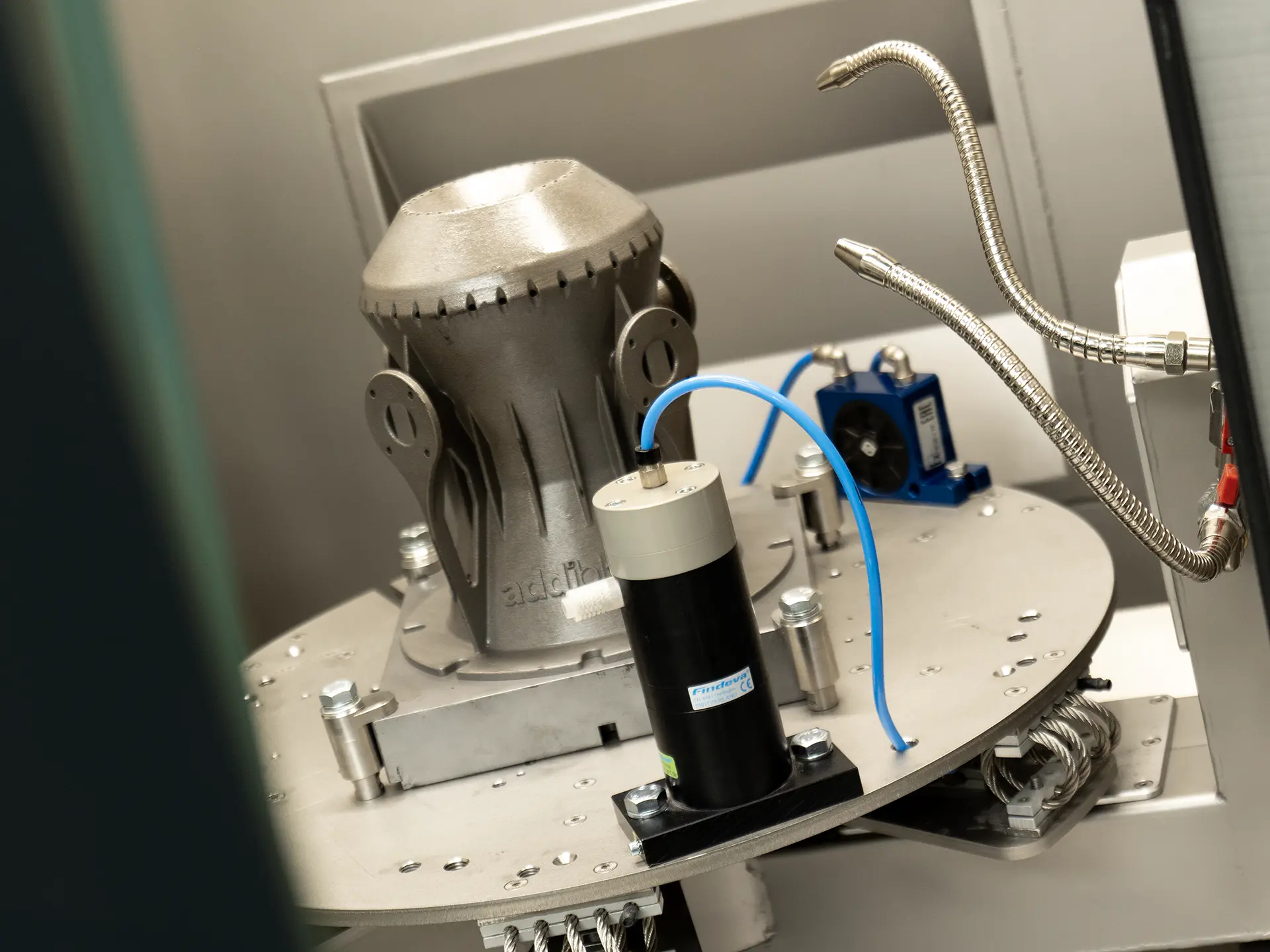
By deploying such safe depowdering systems for metal AM, companies not only protect their employees but also gain operational advantages. For example, one Addiblast customer noted that the MARS03 “enables us to safely and effectively remove excess powder from parts, resulting in reduced material waste with greater confidence”. Another benefit is consistency – automated depowdering yields more uniform results than manual cleaning, which can improve part quality (no more powder stuck in a hidden channel that later causes issues). And of course, when the powder removal is done correctly, downstream processes like heat treatment or surface finishing can proceed without dangerous powder accumulations present. Essentially, MARS helps bridge the gap between printing and finished part in a safe, efficient manner, which is crucial for scaling metal AM to production.
Meeting Aerospace and Defense Safety Requirements
Industries such as aerospace and defense have some of the strictest safety and quality requirements in manufacturing. These are exactly the fields where metal 3D printing is making significant inroads – from 3D printed rocket engine components and satellite parts to aircraft brackets and even defense-related spare parts. In these sectors, there is zero tolerance for safety lapses. A powder fire in an aerospace facility, for instance, could not only injure personnel but also jeopardize costly projects and cause regulatory scrutiny. Therefore, aerospace/defense companies meticulously evaluate the safety of any new manufacturing process, including additive manufacturing. They will ask: Does your depowdering setup meet CE/ATEX standards? Have you conducted a dust hazard analysis? Can you prove that in the worst-case scenario, an explosion would be contained? The Addiblast MARS and related solutions help answer these questions with confidence.
The MARS systems are built to aerospace-grade safety standards, making them well-suited for critical applications. MARS04 and MARS05, for example, were developed to handle large, complex parts like those found in aerospace without sacrificing safety. Their robust explosion-proof design and inerting options mean that even when depowdering a big titanium airframe component or a fuel tank segment, the process remains under control. This capability is not just theoretical – it’s being used. Aerospace companies have adopted these systems to depowder parts like engine combustion chambers and nozzle assemblies, which often involve challenging geometries packed with powder. With MARS, they can achieve thorough powder removal (vital for part performance) while maintaining a sealed inert environment (vital for safety). The result is process reliability that meets both production and EHS (Environment, Health, Safety) goals.
Defense industries similarly benefit since many defense applications use aluminum and titanium alloys (e.g., lightweight parts for military vehicles or ordnance components). Those powders, as discussed, have high fire risk, so an automated inert gas depowdering solution is practically a necessity. Furthermore, defense contractors are typically required to follow MIL-STD safety protocols and often undergo audits – having a clearly ATEX-certified piece of equipment like MARS makes it easier to demonstrate compliance. It’s also worth mentioning that process repeatability and documentation are important in these industries. MARS systems, with their recipe-based runs and data logging, provide documentation that each build was depowdered under controlled conditions. This traceability can feed into overall quality assurance and certifications for the part.
In essence, Addiblast’s safety-focused approach aligns with the stringent demands of aerospace and defense manufacturing. By ensuring that combustible powder handling is as safe as possible, the MARS depowdering and STAR recycling systems allow these industries to embrace metal AM at scale. They can reap the benefits of 3D printing (design freedom, weight reduction, supply chain agility) without compromising on safety or compliance. This is a key enabler for wider adoption of metal additive manufacturing in high-stakes fields.
Conclusion: Safety and Productivity Go Hand in Hand
Metal 3D printing revolutionizes manufacturing – but it also introduces the very real challenge of handling combustible metal powders. As we’ve explored, without proper precautions, those powders can ignite or explode, putting people, facilities, and projects at risk. Fortunately, the industry is rising to the occasion with clear safety protocols and innovative technologies. By rigorously controlling ignition sources, maintaining inert atmospheres, using explosion-proof equipment, and following standards like ATEX and NFPA, companies can create a safe environment for metal AM. It’s not just about avoiding accidents – a well-designed powder handling process also improves efficiency (less waste, faster turnaround) and product quality. Safety in additive manufacturing is thus inextricably linked with productivity and success.
Addiblast’s MARS depowdering systems and related post-processing solutions exemplify how technology can make metal AM safer and more reliable. Through sealed inert chambers, automated powder removal, and compliance-driven design, they eliminate much of the uncertainty and danger from the depowdering step. This gives engineers and EHS managers peace of mind, knowing that combustible powder post-processing is under control. Moreover, integrating depowdering with powder recycling (via the STAR system) and surface finishing (via Addiblast’s BAM blasting cabinets, for instance) creates an end-to-end post-print workflow that is both safe and streamlined. Manufacturers no longer need to jury-rig miscellaneous equipment or resort to manual methods; they can leverage a cohesive solution tailored for AM’s unique needs.
In summary, ensuring safety in metal 3D printing is an achievable goal – it requires respect for the risks and commitment to the right practices and tools. Whether you’re an aerospace innovator 3D printing mission-critical parts, or a research lab exploring new alloys, implementing the proper safety measures from start to finish is paramount. By doing so, you protect your team and facility while enabling the remarkable possibilities that metal AM offers. As additive manufacturing continues to transform industries, solutions like Addiblast’s MARS will play a key role in making sure that transformation is a safe one. Embracing these safety advancements is not just a regulatory checkbox or a cost center – it’s a smart investment into the sustainability and scalability of your metal AM operations. Safety and innovation go hand in hand, and with the right approach to handling combustible powders, we can truly unlock the future of metal 3D printing with confidence.