

Additive manufacturing (AM) doesn't end when a part comes off the 3D printer. Depowdering is a critical post-processing step for powder-bed 3D printing technologies. In fact, depowdering has been called the “Achilles heel” of powder-bed additive manufacturing, underscoring how vital and challenging this process can be. Decision-makers, engineers, and production teams must choose between manual vs. automated depowdering methods to ensure efficiency, consistency, and safety in their workflows. This blog provides a balanced comparison of manual and automated depowdering technologies, discussing pros and cons of each approach while emphasizing additive manufacturing efficiency, cost-effectiveness, consistency, and sustainability in post-processing. We’ll also highlight real-world solutions including Addiblast’s manual MARS01 and automated MARS03/04/05 depowdering systems.
Manual Depowdering in Additive Manufacturing
Manual depowdering involves using human operators and basic tools or equipment to clean off loose powder from 3D printed parts. This often takes place in an enclosed workstation (glove box or blast cabinet) where technicians brush, blast with compressed air, or vibrate the part to dislodge powder.
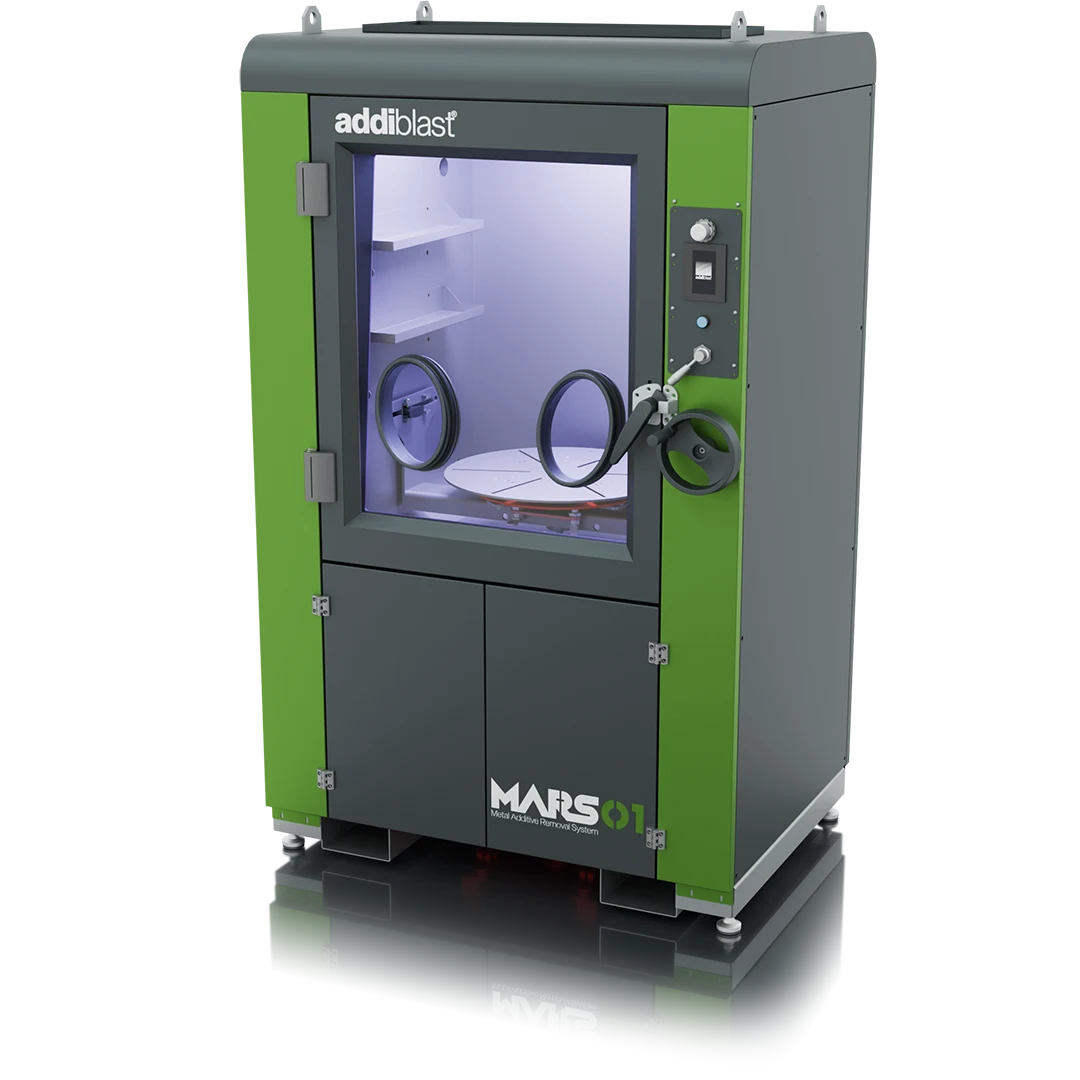
For example, Addiblast’s MARS01 is a dedicated manual depowdering cabinet designed for operators to safely remove powder and supports by hand. It provides an explosion-proof enclosure with a powder collection bin and even a pneumatic vibration system to assist in shaking out powder. The MARS01’s working volume (approximately 300×300×400 mm for parts up to ~150 kg) suits small-to-medium prints, making it ideal for one-off parts, prototypes, or research environments where a skilled touch is needed.
Pros of manual depowdering:
- Low equipment cost: Setting up a manual depowdering station is relatively inexpensive. It typically requires a blast cabinet or simple containment unit and basic tools, making it accessible for small companies or low-volume production.
- Operator control and flexibility: A trained technician can use judgment and finesse to carefully clean delicate or complex parts. Manual methods allow direct visual inspection during cleaning and on-the-spot adjustments to ensure fragile features aren’t damaged. This hands-on approach can be effective for intricate geometries or prototypes that need special attention.
- Suitable for small batches: For limited runs or very small parts, manual depowdering can be efficient enough. In fact, manual handling is particularly useful for small parts and limited runs, where automation might not be justified.
Cons of manual depowdering:
- Labor-intensive and time-consuming: Removing powder by hand does not scale well for larger batches or bigger parts. Each part can require significant time and effort. As production volumes increase, manual post-processing becomes a bottleneck. This means higher labor costs per part and longer lead times.
- Inconsistent results: Quality can vary between operators or even from part to part. The finish and completeness of powder removal depend on individual skill and diligence. Human fatigue or error can lead to residual powder being left in cavities or inconsistent surface quality. In contrast, automation can eliminate this variability, applying the same process repeatably to every part.
- Health and safety risks: Fine powder (especially from metal AM) poses inhalation and explosion hazards. Manual depowdering exposes operators to dust and ergonomic strain from repetitive motions. Without strict safety measures, there’s risk of injury or long-term health issues. Even with enclosure and PPE, manual cleaning can be messy and hazardous compared to sealed automated systems.
- Limited to smaller or simpler parts: Very large, heavy, or complex 3D-printed components are difficult to clean thoroughly by hand. An operator might struggle to access deep internal channels or to handle parts exceeding what a single person can lift or manipulate. This limits manual depowdering to relatively modest part sizes and weights.
Automated Depowdering in Additive Manufacturing
Automated depowdering uses mechanical systems and sometimes robotics to remove powder with minimal manual intervention. These automated powder removal machines typically enclose the part in a chamber and use programmed sequences of vibration, rotation, air jetting, and/or ultrasonic cleaning to dislodge and capture excess powder. Many also integrate vacuum systems and filtering to reclaim powder for reuse. Addiblast’s MARS series provides examples of such technology: the MARS03, MARS04, and MARS05 are fully automated depowdering systems for metal 3D-printed parts, scaled for different part sizes.
The MARS03, for instance, features a servo-driven swivel arm that rotates the part 210° and a pneumatic vibration system to shake loose powder. It handles parts up to about 400×400×400 mm in size, weighing up to 200 kg.
Stepping up in capacity, the MARS04 offers an even larger chamber (~600×600×1000 mm) and an endless 2-axis 360° rotation mechanism for thoroughly cleaning large, intricate parts up to 900 kg.
For extremely large components, the MARS05 extends the envelope to parts as big as 1000 mm in each dimension and over 1,100 kg in weight, using heavy-duty rotation and handling systems. These machines exemplify how automated depowdering technology can be scaled to industrial needs, ensuring even massive prints are cleaned efficiently and safely.

Pros of automated depowdering:
- High efficiency and throughput: Automated systems can significantly save time and improve process efficiency. They perform powder removal faster than manual methods by running optimized cycles (often combining simultaneous actions like vibration and air blast) and can operate on larger batches or continuous workflows.
- Consistent, repeatable results: Automation ensures every part undergoes the same standardized cleaning process. This yields consistent quality and repeatability unattainable with manual labor variability. Complex internal channels are more likely to be fully cleared of powder when using programmed motion (e.g., multi-axis rotation) as opposed to a human trying to reach awkward cavities.
- Reduced labor and cost per part: Although the capital investment is higher, automating depowdering lowers labor requirements and cost per part in volume production. One operator can oversee multiple machines or processes instead of manually cleaning each part. Over time, this translates to lower operational costs, especially as production scales.
- Improved safety and ergonomics: Automated depowdering occurs in enclosed, often vacuum-sealed chambers, which reduces direct operator exposure to hazardous powders. The risk of inhalation or contact with fine particles is minimized, creating a cleaner and safer work environment. Additionally, operators are less burdened by repetitive motions and heavy lifting.
- Better powder recovery and sustainability: Automated machines typically include powder collection and recycling mechanisms. By containing and filtering the excess powder, they allow for reclaiming a high percentage of material for reuse. 90% with automated depowdering systems like the MARS03, along with a safer operating environment.
Cons of automated depowdering:
- High initial investment: Automated depowdering equipment represents a significant capital expense. The sophisticated machinery (with mechanical arms, sensors, and control systems) costs substantially more than a basic manual setup. For organizations with low production volume or tight budgets, this investment may be hard to justify initially.
- Requires expertise and maintenance: Implementing automation means operators must be trained on the system’s software and maintenance. While user-friendly interfaces are common, there is a learning curve to properly program and load parts for automated cleaning. Regular maintenance is needed to keep sensors, motors, and filters in top condition.
- Less flexible for one-off tweaks: Automated processes are optimized for standard routines. If a part has an unusual feature or needs special attention, the machine’s fixed program might not address it as intuitively as a human would. For example, if some stubborn powder remains, an automated cycle may need to be re-run or adjusted, whereas a person could spot and fix it on the fly.
- Space and infrastructure requirements: Large automated depowdering units (like MARS04 or MARS05) have a considerable footprint and may require facility upgrades (for power, ventilation, or floor space). Not every shop has the room or utilities set up for a 2-meter-plus machine.
Efficiency and Throughput Comparison
When comparing manual and automated depowdering, efficiency is one of the most obvious differentiators. Manual depowdering relies on human speed and stamina. An operator might spend significant time blowing out powder from crevices or gently brushing a single complex part. If dozens or hundreds of parts need depowdering, this method becomes a serious bottleneck. In contrast, automated depowdering systems work much faster and can handle higher throughput. They use programmed cycles that optimize powder removal in minutes rather than the extended periods a person might take for the same task. As noted, many users turn to automated systems specifically because they save time and improve process efficiency in post-processing. For example, an automated cycle can run unattended, even overnight, whereas manual work stops when staff are unavailable.
Another aspect of throughput is parallelization. In a manual process, multiple operators would be needed to clean multiple parts simultaneously, multiplying labor costs. Automated solutions can often process multiple parts in one batch or allow one technician to supervise several machines at once. This means that as your 3D printing production grows, automating depowdering prevents it from becoming a labor bottleneck, enabling scalable production. Companies aiming to boost additive manufacturing efficiency for large batch manufacturing will find automation almost essential for post-processing to keep up with print capacities. On the other hand, for a small number of parts or very occasional printing, manual depowdering might be sufficiently efficient without the need for automation. The key is to match the method to the production demand: manual methods for low volume or prototyping, automated methods for high volume or fast turnaround requirements.
Quality and Consistency
Quality of post-processing – in terms of how clean the parts are and if any surface or geometric details are affected – is another critical factor. With manual depowdering, consistency can be a challenge. Each operator may apply slightly different techniques or thoroughness. One part might end up perfectly powder-free, while another has a bit of residue in a deep channel because the operator didn’t see it or access it well. Human factors like fatigue or rush can lead to variation. As a result, manual post-processing introduces variability, since outcomes depend on individual skills and methods. In industries where parts must meet strict quality standards (for example, functional aerospace or medical components), such variability can lead to defects or require additional quality inspections to catch incomplete cleaning.
Automated depowdering provides a level of consistency and repeatability that manual methods struggle to achieve. Once an automated system is programmed for a part or build, it will execute the same motions and cleaning parameters every time. Every part in a batch gets equal treatment – the same vibration intensity, the same rotation angles, the same duration of air blast – eliminating the guesswork. This standardized approach leads to uniformly cleaned parts with reliable quality. As noted by AM experts, automation ensures each part undergoes the same standardized process, improving surface quality and part performance through consistent depowdering. It also reduces the risk of human error: the machine won’t “forget” to blast a hidden cavity if it’s been programmed to do so.
In terms of part quality, automated systems can be gentler on parts in some cases as well. A controlled vibration and rotary movement can free powder without scratching or scraping the part’s surface, whereas an overzealous manual brush or tool could accidentally mar a delicate feature. Additionally, some automated depowdering units have sensors or cameras to monitor the process, helping ensure that the cleaning is thorough before a part is declared finished. This level of in-process monitoring and feedback is hard to replicate with manual labor alone. The result is higher confidence in the cleanliness and quality of each part as it moves to further post-processing or end use. For decision-makers focused on quality assurance, the repeatable consistency of automated depowdering is a major advantage.
Cost-Effectiveness and Scaling
Cost is often the deciding factor when choosing between manual and automated post-processing. Manual depowdering may appear cost-effective initially because it requires minimal equipment and uses existing labor. If you already have technicians, you might simply allocate their time to depowdering tasks. This low barrier to entry is why many small operations start with manual cleaning. However, as production scales up, the economics shift. Manual post-processing can be labor-intensive and costly, especially as volumes increase. Each additional part requires more hands-on time, so to double output you might need to double labor hours (or personnel). Labor costs can quickly outweigh any savings from not investing in automation. Moreover, humans working long hours on repetitive tasks can lead to overtime pay, fatigue-related mistakes, or higher turnover.
Automated depowdering systems have a high upfront cost, but they drastically reduce the labor required per part and ensure consistent throughput, leading to lower cost per part in volume production. Once the machine is in place, the marginal cost of cleaning each additional part is very low – the main costs are machine depreciation, maintenance, and energy, not direct labor. This means the breakeven point for automation is often reached when you have enough volume to keep the machine well utilized. For example, if a manual method allows one person to clean 5–10 parts per hour, but an automated machine can clean 30 parts in that same hour with the operator only needed briefly to load/unload, the cost per part drops dramatically when the system is busy. Over time, automation can pay for itself by reducing labor costs and increasing throughput.
Another cost consideration is scrap or rework. Inconsistent manual cleaning might lead to some parts being rejected or requiring additional processing if powder is found later (say, during thermal post-processing or inspection). These hidden costs can erode profitability. Automated cleaning’s reliability can improve yield, ensuring parts are truly ready for subsequent steps or delivery, thus protecting your investment in printing those parts in the first place.
For companies aiming to scale their additive manufacturing from prototyping to production, investing in automation is often a strategic decision. It future-proofs the operation by putting infrastructure in place that can handle growing demand without proportionally growing labor. In other words, automated post-processing enables scalable operations – you can ramp up production knowing your depowdering stage can keep pace. Of course, each organization must run the numbers based on their specific throughput and workforce costs. In some cases, a hybrid approach might be cost-optimal: using manual methods for very low-volume, custom jobs, and automated methods for standard, repeatable production runs. The cost-effectiveness ultimately ties back to how well the chosen method aligns with the production volume and the value of time saved.
Safety and Sustainability
Both safety and sustainability have become increasingly important in additive manufacturing operations. Manual depowdering poses several safety challenges. Operators are directly exposed to fine powders that can be toxic or combustible. Even with masks or respirators, ultra-fine metal or polymer particles can be inhaled, and prolonged exposure may lead to health issues. Physically, the tasks can be strenuous – lifting heavy parts, holding awkward positions to reach cavities, or repetitive blasting can cause fatigue or injuries. By contrast, automated systems greatly improve workplace safety and ergonomics. Since the depowdering process takes place in a closed chamber, the operator is not in direct contact with the powder. The chamber’s ventilation and filtration systems handle dust, often maintaining negative pressure so no powder escapes into the room. This containment not only protects the worker’s lungs, but also keeps the workshop cleaner and compliant with health regulations. Automation also means the machine, not the human, is doing the heavy shaking and handling of the part.
Explosion risk is another safety aspect. Many metal powders (like aluminum or titanium alloys) are flammable in fine particle form. Manual handling in open air (or even a basic cabinet) introduces risk of a dust explosion if a spark or static discharge occurs. Automated depowdering units are built with explosion-proof designs and can include features like inert gas purging to eliminate oxygen during cleaning. This makes processing reactive powders much safer. For decision-makers, these safety features can be a strong reason to favor automation.
On the sustainability front, automated depowdering has clear benefits in terms of material and resource efficiency. In manual cleaning, a significant portion of the excess powder may end up scattered, contaminated, or dumped as waste. It’s difficult to manually collect every bit of powder for reuse. Automated systems, on the other hand, are designed to enhance material recovery rates, reducing powder waste. Powder is usually funneled into a collection bin or through a sieving system so it can be recycled back into the printer feedstock. As mentioned, companies using automated depowdering have seen greater than 90% powder recovery, which drastically cuts down on new powder purchases and waste disposal. This not only saves cost but also conserves resources by reusing material.
Energy and consumables use is another factor. Manual processes might use a lot of compressed air continuously or single-use cleaning media (like blasting media) that then become waste. An optimized automated process can be tuned to use just enough energy to clean the part, often completing the task faster (so equipment runs for less time per part). Some systems even reuse blasting media or use the part’s own powder as abrasive in clever ways. Overall, automation tends to be more controlled, which means less wasted energy and materials, contributing to a greener production approach. Finally, by improving safety (less contamination, less spillage), automated depowdering also ensures that environmental contamination is minimized. For organizations with sustainability goals, the reduction in waste and improved energy efficiency make automated depowdering an attractive component of an eco-conscious additive manufacturing workflow.
Choosing the Right Depowdering Solution for AM Efficiency
Depowdering may happen behind the scenes in the additive manufacturing process, but its impact on production efficiency, part quality, and overall workflow is front and center. Choosing between manual and automated depowdering comes down to evaluating your specific needs: the scale of production, part sizes and complexities, quality requirements, budget, and workforce considerations. Manual depowdering is reliable for small-scale operations or highly specialized one-off jobs where human flexibility is valuable. However, as this comparison has shown, manual methods can fall short in consistency, speed, and safety for larger workloads. Automated depowdering systems shine in high-efficiency, high-repeatability scenarios, ensuring that powder removal is not the weak link in your post-processing chain. They bring significant gains in throughput, uniformity, and powder recycling.
In making a decision, consider the pros and cons outlined above in light of your production goals. It’s often helpful to conduct a pilot or ROI analysis: How much time and labor could automation save per build? What quality improvements or risk reductions would that bring? For many, the answer points toward at least partial automation to keep up with the advances in 3D printing productivity. Fortunately, solutions exist at every level. As we highlighted with Addiblast’s MARS lineup, you can start with a manual setup like MARS01 and eventually scale up to automated systems (MARS03/04/05) as your needs grow.
Finally, if you’re looking to improve your AM post-processing, consider exploring advanced depowdering solutions. Modern equipment and techniques can dramatically streamline your workflow and alleviate the common pain points of powder removal. It’s a worthwhile exploration to speak with post-processing experts or providers like Addiblast, who have deep expertise in both manual and automated depowdering. They can help identify the right solution for your requirements that will enhance your additive manufacturing efficiency without compromising safety or quality. By choosing the right depowdering approach, you’ll not only boost productivity and consistency, but also reinforce a sustainable and safe production environment. In the fast-evolving world of AM, that is a competitive advantage you don’t want to overlook.